<?xml version="1.0" encoding="UTF-8"?><feed xmlns="http://www.w3.org/2005/Atom" xmlns:dc="http://purl.org/dc/elements/1.1/">
                                        <id>https://www.fractionalcmto.com/insights</id>
                                            <link rel="self" href="https://www.fractionalcmto.com/insights"></link>
                                <title><![CDATA[Insights]]></title>
                                                                                                                <updated>2026-01-16T14:15:09+00:00</updated>
                        
            <entry>
            <title><![CDATA[Understanding Technical Marketing: A Comprehensive Overview and Guide]]></title>
            <link rel="alternate" href="https://www.fractionalcmto.com/insights/marketing/understanding-technical-marketing-a-comprehensive-overview-and-guide-1" />
            <id>https://www.fractionalcmto.com/insights/marketing/understanding-technical-marketing-a-comprehensive-overview-and-guide-1</id>
            <author>
                <name><![CDATA[Fractional CMTO]]></name>
                                    <email><![CDATA[4937@ucraft.forento.io]]></email>
                            </author>
            <summary type="html">
                <![CDATA[<header class="entry-header"></header>
<h2 class="wp-block-heading">What is Technical Marketing?</h2>
<p>Technical marketing communicates a product’s technical features to an expert audience, combining technical writing with strategic marketing. It combines elements of <strong>technical writing</strong> with strategic <strong>content marketing</strong> to highlight the <strong>advanced technical</strong> features and <strong>technical specifications</strong> of a product. Unlike <strong>traditional marketing</strong>, which often emphasises emotional appeals, <strong>technical marketing</strong> prioritises factual information and <strong>technical details</strong>, making it essential for industries that rely heavily on technology.</p>
<p>The <strong>marketing team</strong> plays a crucial <strong>role in technical marketing</strong>, developing <strong>marketing materials</strong> that effectively communicate complex information. This includes using <strong>technical SEO</strong> strategies to ensure that relevant content reaches the right audience. While <strong>regular marketing</strong> might focus on broader appeals, <strong>technical marketing</strong> requires a deep understanding of the <strong>technical expertise</strong> behind the product, allowing it to serve as a powerful <strong>marketing tool</strong> for <strong>marketing agencies</strong> and businesses alike.</p>
<p> </p>
<h3 class="wp-block-heading">Definition of Technical Marketing</h3>
<p><em>Technical marketing is a specialized approach that highlights a product’s technical aspects, designed to communicate complex information clearly to a technical audience</em>. It involves creating effective <strong>marketing content</strong> that communicates complex information clearly and engagingly. This is crucial as <strong>technical marketing</strong> is important for businesses that rely on intricate products, requiring a deep understanding of both the product and the market. <em>Professionals often come from technical backgrounds, allowing them to effectively promote intricate products</em></p>
<p> </p>
<p>Many technical roles engage in various <strong>marketing activities</strong>, from developing <strong>technical documentation</strong> to implementing technical marketing strategies. Those pursuing a <strong>career in technical marketing</strong> can expect to handle multiple <strong>marketing tasks</strong> that require a blend of creativity and analytical skills. The <strong>average salary for a technical marketing</strong> professional often reflects the specialized nature of the role, with the <strong>salary for a technical marketing</strong> expert varying based on experience and location. <strong>Technical marketing</strong> dives into addressing <strong>frequently asked questions</strong> that potential customers may have, ensuring that the technical aspects of a product are clearly communicated and understood.</p>
<p> </p>
<h3 class="wp-block-heading">Importance of Technical Marketing in Today</h3>
<p><em>Technical marketing is crucial in today’s fast-paced, technology-driven landscape</em>. As organizations increasingly rely on digital solutions, the role of a <strong>technical marketing writer</strong> has become paramount. This <strong>specific type of marketing</strong> focuses on communicating complex <strong>technical information</strong> effectively, bridging the gap between technology and marketing. In this context, <strong>technical marketers must</strong> possess a blend of <strong>technical proficiency</strong> and strong communication skills to create impactful campaigns.</p>
<p> </p>
<p><strong>Overall marketing</strong> strategies often fall short without the inclusion of <strong>technical marketing content</strong>. <strong>Technical marketing can provide</strong> valuable insights and <strong>in-depth technical</strong> knowledge that enhances customer understanding and engagement. By leveraging <strong>various technical</strong> <strong>marketing techniques</strong>, businesses can effectively showcase their products’ capabilities and benefits. <strong>Technical marketing might</strong> involve the creation of detailed white papers, case studies, and webinars that convey complex concepts in an accessible manner, ensuring that potential customers are well-informed and empowered to make decisions.</p>
<p> </p>
<p><em>As technology advances, the demand for technical marketers will rise</em>. <strong>Technical marketers</strong> who can seamlessly integrate <strong>technology and marketing</strong> will play a crucial role in shaping the future of customer engagement. In this dynamic environment, <strong>many technical marketing</strong> professionals will need to adapt their strategies to meet the ever-changing expectations of their audiences.</p>
<p> </p>
<h3 class="wp-block-heading">Key Components of Technical Marketing</h3>
<p>The <strong>technical marketing role</strong> plays a crucial part in bridging the gap between <strong>product marketing</strong> and the <strong>technical side</strong> of a business. <strong>Technical marketing includes</strong> a variety of tasks, often requiring a blend of <strong>years of marketing experience</strong> and <strong>strong research skills</strong>. <em>Technical marketers collaborate closely with technical writers to produce comprehensive, accessible documentation that resonates with their target audience.</em></p>
<p> </p>
<p><strong>Technical marketing</strong> can take many forms, from developing <strong>marketing technologies</strong> to implementing <strong>technical marketing tools</strong> that streamline <strong>marketing operations</strong>. While some aspects may involve <strong>non-technical marketing</strong>, the focus remains on conveying complex information in an accessible manner. <strong>Hiring a technical marketing agency</strong> can significantly enhance a company’s outreach, allowing them to tap into the broader <strong>marketing community</strong> and effectively position their products in the marketplace.</p>
<p> </p>
<h2 class="wp-block-heading">How to Use Technical Marketing Effectively?</h2>
<p>Marketing professionals must adapt to new strategies and technologies to stand out. <strong>Marketing often</strong> requires a blend of creativity and analytical skills, making it essential to leverage various tools and techniques. One effective approach is incorporating <strong>technical marketing</strong> into your campaigns. Effective technical marketing uses data analytics, automation, and advanced targeting to tailor messages precisely to audience needs, optimizing ROI.<strong>Technical marketing helps</strong> streamline processes, optimize performance, and ultimately improve return on investment.</p>
<p> </p>
<p>However, it’s important to remember that <strong>marketing is a tough</strong> landscape, and staying relevant requires continuous learning. Professionals in <strong>marketing or a related field</strong> should keep abreast of emerging technologies and trends to ensure their strategies remain effective. By combining traditional marketing principles with technical insights, marketers can create more impactful campaigns that resonate with their target audience.</p>
<p> </p>
<h3 class="wp-block-heading">Implementing a Successful Technical Marketing Strategy</h3>
<p>Implementing a successful <strong>technical marketing strategy</strong> requires a well-defined plan that aligns with both business goals and customer needs. First, it’s crucial to conduct thorough <strong>market research</strong> to understand the target audience, their pain points, and how your product can address these challenges. This information forms the backbone of your messaging and content.</p>
<p> </p>
<p>Next, create high-quality <strong>content</strong> that showcases your technical expertise while remaining accessible to your audience. This might include whitepapers, case studies, blogs, and video tutorials, all designed to educate potential customers about your solutions. Additionally, leveraging <strong>SEO</strong> techniques will ensure that your content reaches the right audience.</p>
<p>Finally, measure the success of your strategy through analytics and feedback. Regularly assess key performance indicators such as engagement rates and conversion metrics. This iterative approach allows for continuous improvement and ensures that your <strong>technical marketing strategy</strong> remains effective in a rapidly changing landscape.</p>
<p> </p>
<h3 class="wp-block-heading">Best Practices for Technical Marketing Campaigns</h3>
<p>Define your target audience first. Understanding their needs ensures that technical content resonates and drives engagement. Understanding their needs and pain points allows for the creation of tailored content that resonates. Utilising <strong>data analytics</strong> can further refine this targeting, helping to identify the most effective channels and messaging.</p>
<p>Next, invest in high-quality <strong>content creation</strong>. This should encompass a variety of formats, such as blog posts, whitepapers, and videos, to cater to different preferences. Incorporating <strong>SEO best practices</strong> will enhance visibility and drive organic traffic to your campaign materials.</p>
<p> </p>
<p>Additionally, leveraging <strong>social media</strong> platforms and professional networks can amplify your reach. Engaging with audiences through webinars and Q&amp;A sessions fosters trust and positions your brand as an industry leader. Finally, always measure campaign performance using <strong>KPIs</strong> to continuously optimize your strategy for future initiatives.</p>
<p> </p>
<h3 class="wp-block-heading">Utilizing Analytics in Technical Marketing</h3>
<p><strong>Utilising</strong> analytics in technical marketing is essential for understanding customer behaviour and optimising marketing strategies. Analysing website traffic, social media interactions, and email campaigns provides valuable insights into customer behaviour, enabling more effective targeting. This information allows marketers to tailor their messaging and improve user experience, thus increasing conversion rates.</p>
<p> </p>
<p>Furthermore, <strong>analytics</strong> enables organisations to track the performance of their marketing initiatives in real-time. By setting up key performance indicators (KPIs), teams can measure the effectiveness of different tactics and make data-driven decisions. This iterative approach ensures that resources are allocated efficiently, maximising return on investment.</p>
<p>In addition, <strong>predictive analytics</strong> can be employed to forecast future trends and customer needs. By analyzing historical data, marketers can identify patterns that inform product development and promotional strategies, ultimately leading to a more targeted and successful marketing effort.</p>
<p> </p>
<h2 class="wp-block-heading">What Skills Does a Technical Marketing Manager Need?</h2>
<p>To excel as a <strong>Technical Marketing Manager</strong>, a diverse skill set is essential. First and foremost, a strong foundation in <strong>digital marketing strategies</strong> is crucial, as this role often involves leveraging online platforms to reach target audiences effectively. Understanding <strong>SEO</strong>, <strong>content marketing</strong>, and <strong>social media</strong> is vital for driving engagement and conversions.</p>
<p>Additionally, possessing <strong>technical knowledge</strong> related to the products or services being marketed is important. This includes familiarity with software, tools, and industry trends to communicate effectively with both technical teams and customers. Strong <strong>analytical skills</strong> are also necessary to assess campaign performance and make data-driven decisions that optimize marketing efforts.</p>
<p> </p>
<p>Moreover, excellent <strong>communication skills</strong> are paramount, enabling the manager to articulate complex concepts clearly and persuade various stakeholders. Finally, a knack for <strong>project management</strong> ensures that marketing initiatives are executed efficiently, on time, and within budget.</p>
<p> </p>
<h3 class="wp-block-heading">Essential Technical Marketing Skills</h3>
<p><strong>Technical marketing skills</strong> are crucial for professionals in the digital landscape, as they bridge the gap between marketing strategy and technology. Proficiency in <strong>data analysis</strong> allows marketers to interpret consumer behavior and make informed decisions, enhancing campaign effectiveness. Moreover, a solid understanding of <strong>SEO</strong> (Search Engine Optimization) is vital for improving a website’s visibility and driving organic traffic. This skill involves optimizing content and structure to align with search engine algorithms.</p>
<p> </p>
<p>Additionally, familiarity with <strong>marketing automation</strong> tools is essential for streamlining processes and improving efficiency. These tools help in managing campaigns, tracking user interactions, and nurturing leads. Furthermore, knowledge of <strong>social media analytics</strong> enables marketers to assess engagement levels and refine their strategies accordingly, ensuring they reach their target audiences effectively.</p>
<p> </p>
<p>Finally, having a grasp of <strong>content management systems</strong> (CMS) empowers marketers to create, publish, and manage digital content efficiently, ensuring a cohesive brand message across platforms.</p>
<p> </p>
<h3 class="wp-block-heading">Skills and Tips for Aspiring Technical Marketers</h3>
<p>For aspiring <strong>technical marketers</strong>, developing a strong foundation in both <strong>marketing principles</strong> and <strong>technical skills</strong> is essential. Mastering data analytics tools like Google Analytics and Tableau is essential for interpreting data and refining strategies.Additionally, understanding <strong>SEO</strong> and <strong>content optimisation</strong> can significantly enhance your ability to drive organic traffic.</p>
<p> </p>
<p>Staying updated with the latest <strong>digital marketing trends</strong> is crucial. Stay updated by learning through courses and networking at industry events. Networking with other professionals can also provide valuable insights and learning opportunities.</p>
<p> </p>
<p>Lastly, honing your <strong>communication skills</strong> is vital. Being able to translate complex technical concepts into accessible language for non-technical stakeholders will set you apart in this field. Remember, a successful technical marketer is both a strategist and a storyteller.</p>
<p> </p>
<h3 class="wp-block-heading">Role of a Marketing Manager in Technical Marketing</h3>
<p>The role of a <strong>Marketing Manager</strong> in <strong>Technical Marketing</strong> is critical for bridging the gap between complex products and target audiences. Marketing managers need a deep understanding of both the product and market to align strategies with technical features. This involves conducting thorough market research to identify customer needs and preferences, ensuring that the marketing strategies align with the technical specifications of the products offered.</p>
<p> </p>
<p>In addition, the marketing manager is responsible for developing <strong>marketing campaigns</strong> that highlight the technical benefits and features of the products. This includes creating engaging content, such as white papers, case studies, and technical documentation, that not only informs but also resonates with potential clients. Collaborating with product development and sales teams is essential to ensure that marketing efforts are cohesive and that customer feedback is integrated into future product enhancements.</p>
<p> </p>
<p>Finally, monitoring and analyzing the effectiveness of marketing strategies through key performance indicators (KPIs) is vital. By assessing campaign performance and customer engagement, the <strong>Marketing Manager</strong> can refine tactics to boost reach and drive sales in a competitive technical landscape.</p>
<p> </p>
<h2 class="wp-block-heading">What Are the Best Practices for Technical Marketing?</h2>
<p>Effective <strong>technical marketing</strong> requires a strategic approach that combines in-depth product knowledge with a clear understanding of the target audience. First, it is essential to create <strong>compelling content</strong> that resonates with potential customers. This includes whitepapers, case studies, and blog posts that highlight the technical aspects and benefits of a product or service. Engaging multimedia elements, such as videos and infographics, can also enhance understanding.</p>
<p> </p>
<p>Another best practice is to utilise <strong>data-driven insights</strong> for targeted marketing efforts. Analysing customer behaviour and preferences allows marketers to tailor their campaigns, ensuring that the right message reaches the right audience. Additionally, leveraging <strong>SEO strategies</strong> can improve visibility and drive organic traffic to technical content, making it easier for potential customers to find relevant information.</p>
<p> </p>
<p>Lastly, fostering <strong>customer engagement</strong> through various channels, such as social media and webinars, can help build a community around the product. By encouraging feedback and interaction, technical marketers can better understand customer needs and adapt their strategies accordingly.</p>
<p> </p>
<h3 class="wp-block-heading">Creating Engaging Technical Content</h3>
<p><strong>Creating</strong> engaging <strong>technical</strong> content requires a careful balance between clarity and depth. It’s essential to understand your audience and tailor your material accordingly, ensuring that complex concepts are broken down into digestible pieces. Using <strong>visual aids</strong> like diagrams and infographics can significantly enhance comprehension, making it easier for readers to grasp intricate ideas.</p>
<p> </p>
<p>Additionally, incorporating real-world examples and case studies can make the content more relatable and practical. This not only enriches the reader’s understanding but also keeps them invested in the subject matter. Employing a conversational tone can further help in drawing readers in, making the content feel less daunting.</p>
<p> </p>
<p>Finally, don’t underestimate the power of <strong>SEO</strong> in technical writing. Optimizing your content with relevant keywords ensures it reaches a wider audience, allowing more people to benefit from your insights.</p>
<p> </p>
<h3 class="wp-block-heading">Leveraging SEO in Technical Marketing</h3>
<p>In today’s digital landscape, leveraging <strong>SEO</strong> in <strong>technical marketing</strong> is essential for driving organic traffic and enhancing brand visibility. By optimizing website structures, incorporating relevant <strong>keywords</strong>, and improving page load speeds, technical marketers can create a more user-friendly experience that aligns with search engine algorithms. This ensures that content is not only discoverable but also engaging for the target audience.</p>
<p> </p>
<p>Moreover, employing <strong>schema markup</strong> can significantly enhance search visibility by providing search engines with more context about the content. This structured data helps in improving click-through rates by making search results more informative. Additionally, technical marketing strategies should incorporate regular <strong>SEO audits</strong> to identify and rectify any potential issues that could impact a website’s performance.</p>
<p> </p>
<p>Ultimately, a well-executed <strong>SEO</strong> strategy in technical marketing can lead to increased conversions, higher search rankings, and a more robust online presence. By staying informed about the latest trends and algorithms, businesses can continually refine their approach for sustained success.</p>
<p> </p>
<h3 class="wp-block-heading">Target Audience Considerations in Technical Marketing</h3>
<p>When developing a technical marketing strategy, understanding the <strong>target audience</strong> is crucial. Different segments of the market may have varying levels of familiarity with the technology being promoted. For instance, marketing to <strong>engineers</strong> might require a focus on specifications and performance metrics, whereas outreach to <strong>executives</strong> may prioritize cost-effectiveness and strategic benefits.</p>
<p> </p>
<p>Additionally, <strong>demographics</strong> such as age, education, and industry experience play a significant role in shaping messaging. Younger audiences might respond better to digital content and social media campaigns, while seasoned professionals may prefer in-depth white papers or case studies.</p>
<p> </p>
<p>Furthermore, understanding the <strong>pain points</strong> and challenges faced by the target audience can help tailor the marketing approach. Addressing these issues directly can enhance engagement and foster a connection between the product and potential customers, leading to higher conversion rates.</p>
<p> </p>
<h2 class="wp-block-heading">What Are Common Marketing Strategies in Technical Marketing?</h2>
<p>In the realm of technical marketing, several <strong>common strategies</strong> are employed to effectively reach and engage target audiences. One prevalent approach is <strong>content marketing</strong>, which involves creating informative and valuable content such as whitepapers, case studies, and technical blogs that demonstrate expertise and address customer pain points. This not only helps in building brand credibility but also aids in search engine optimization (SEO), driving organic traffic to the website.</p>
<p> </p>
<p>Another key strategy is <strong>email marketing</strong>, where businesses nurture leads through personalized communication and tailored campaigns. By segmenting their audience and delivering relevant content, companies can improve engagement and conversion rates. Additionally, leveraging <strong>social media platforms</strong> can enhance visibility and facilitate interaction with potential customers, allowing for real-time feedback and community building.</p>
<p> </p>
<p>Lastly, <strong>webinars</strong> and <strong>live demonstrations</strong> serve as powerful tools in technical marketing, enabling businesses to showcase their products or services in action while providing an interactive experience for participants. This not only educates potential customers but also fosters trust and rapport, which are crucial in the technical industry.</p>
<p> </p>
<h3 class="wp-block-heading">Types of Marketing Strategies for Technical Products</h3>
<p>When it comes to promoting <strong>technical products</strong>, businesses often employ a variety of tailored <strong>marketing strategies</strong> to effectively reach their target audience. One popular approach is <strong>content marketing</strong>, which involves creating informative articles, videos, and tutorials that highlight the product’s features and benefits. This helps establish the brand as a thought leader in the industry while also educating potential customers.</p>
<p> </p>
<p>Another effective strategy is <strong>digital marketing</strong>, which encompasses social media campaigns, email marketing, and search engine optimization (SEO). These tactics enable companies to engage directly with their audience, driving traffic to their website and increasing conversion rates. Additionally, leveraging <strong>influencer partnerships</strong> can enhance credibility and expand reach by tapping into established networks.</p>
<p> </p>
<p>Lastly, utilizing <strong>trade shows</strong> and industry events can provide an excellent platform for hands-on demonstrations and real-time interactions, allowing potential customers to experience the product first-hand. Combining these strategies can lead to a comprehensive marketing plan that effectively promotes <strong>technical products</strong>.</p>
<p> </p>
<h3 class="wp-block-heading">Integrating Digital Marketing with Technical Marketing</h3>
<p>Integrating <strong>Digital Marketing</strong> with <strong>Technical Marketing</strong> is crucial for modern businesses seeking to enhance their outreach and engagement. While <strong>Digital Marketing</strong> focuses on online strategies to attract and retain customers, <strong>Technical Marketing</strong> delves into the specifics of product functionality, features, and benefits. This synergy allows companies to present a comprehensive narrative that resonates with both technical and non-technical audiences.</p>
<p> </p>
<p>By combining these two approaches, organizations can create targeted campaigns that highlight the technical aspects of their products while leveraging digital channels for maximum visibility. For example, informative blog posts, webinars, and social media campaigns can be designed to educate potential customers about complex products while simultaneously driving traffic and generating leads.</p>
<p> </p>
<p>Moreover, utilizing data analytics from <strong>Digital Marketing</strong> can provide invaluable insights into customer behavior, enabling <strong>Technical Marketing</strong> strategies to be refined and optimized. This integration fosters a deeper understanding of consumer needs and preferences, ultimately leading to more effective marketing efforts.</p>
<p> </p>
<h3 class="wp-block-heading">Comparison of Traditional and Technical Marketing Approaches</h3>
<p>When comparing <strong>Traditional Marketing</strong> and <strong>Technical Marketing</strong>, several key differences emerge. Traditional marketing primarily relies on established methods such as print advertisements, television commercials, and direct mail campaigns. These approaches focus on broad audience outreach and brand awareness, often emphasizing emotional appeal and storytelling to connect with consumers. On the other hand, technical marketing leverages digital tools and analytics to engage audiences more precisely. This includes the use of <strong>SEO</strong>, <strong>content marketing</strong>, and social media strategies that allow for real-time tracking and optimization.</p>
<p> </p>
<p>Additionally, traditional marketing tends to have a more passive approach, where consumers receive information without immediate interaction. In contrast, technical marketing encourages active participation through interactive content and personalized experiences. Furthermore, while traditional methods can be costly and less measurable, technical marketing offers a cost-effective solution with quantifiable results, enabling businesses to adapt their strategies quickly based on consumer behavior and preferences.</p>
<p> </p>
<h2 class="wp-block-heading">What is the Role of Analytics in Technical Marketing?</h2>
<p><strong>Analytics</strong> plays a crucial role in <strong>technical marketing</strong> by providing data-driven insights that inform decision-making and strategy development. Through the collection and analysis of various metrics, marketers can understand customer behavior, preferences, and engagement patterns, leading to more effective targeting and positioning of products or services.</p>
<p>By leveraging <strong>analytics</strong>, technical marketers can optimize campaigns in real-time, adjusting tactics based on performance data. This iterative approach allows for continuous improvement, ensuring that marketing efforts resonate with the intended audience. Furthermore, <strong>analytics</strong> helps in identifying trends and forecasting future market developments, enabling companies to stay ahead of the competition.</p>
<p> </p>
<p>Ultimately, the integration of <strong>analytics</strong> into technical marketing not only enhances operational efficiency but also fosters a culture of accountability and transparency. This empowers teams to make informed decisions, leading to better ROI and long-term success.</p>
<p> </p>
<h3 class="wp-block-heading">Using Analytics to Measure Marketing Efforts</h3>
<p>In today’s data-driven world, utilizing <strong>analytics</strong> to measure <strong>marketing efforts</strong> is essential for businesses aiming to optimize their strategies. By collecting and analyzing data from various channels, marketers can gain insights into customer behavior and preferences, allowing for more targeted campaigns. This process involves tracking key performance indicators (KPIs) such as conversion rates, website traffic, and engagement levels.</p>
<p> </p>
<p>Furthermore, <strong>analytics</strong> enables companies to assess the effectiveness of their <strong>marketing</strong> activities in real-time. This agility allows for quick adjustments to campaigns, ensuring resources are allocated efficiently. Tools like Google Analytics and social media insights provide valuable metrics that help in understanding what resonates with the audience.</p>
<p>Incorporating <strong>analytics</strong> not only aids in measuring success but also supports informed decision-making. By leveraging data, businesses can refine their marketing strategies, enhance customer experiences, and ultimately drive growth.</p>
<p> </p>
<h3 class="wp-block-heading">Key Metrics for Evaluating Technical Marketing Success</h3>
<p>When evaluating the success of technical marketing efforts, several <strong>key metrics</strong> should be considered. Firstly, <strong>lead generation</strong> is crucial; tracking the number and quality of leads produced through campaigns can indicate effectiveness in attracting potential customers. Additionally, examining <strong>conversion rates</strong> helps assess how well these leads are being nurtured into paying clients.</p>
<p> </p>
<p>Another important metric is <strong>customer engagement</strong>. This can be measured through metrics like website traffic, social media interactions, and email open rates, which provide insights into how well the target audience is responding to marketing initiatives. Furthermore, assessing <strong>return on investment (ROI)</strong> is essential to understand the financial impact of marketing strategies and ensure resources are being allocated efficiently. By closely monitoring these metrics, businesses can refine their technical marketing approaches for greater success.</p>
<p> </p>
<h3 class="wp-block-heading">Adjusting Strategies Based on Analytical Insights</h3>
<p>Adjusting strategies based on <strong>analytical insights</strong> is crucial for organizations aiming to remain competitive in today’s fast-paced environment. By leveraging data analytics, businesses can identify trends and patterns that inform decision-making processes. This approach enables organizations to pivot their strategies effectively, ensuring they align with current market demands and consumer behavior.</p>
<p> </p>
<p>Moreover, <strong>real-time data</strong> allows companies to assess the impact of their actions promptly. By continuously monitoring key performance indicators, they can make informed adjustments that enhance operational efficiency and customer satisfaction. Emphasizing a data-driven culture fosters adaptability, enabling teams to respond swiftly to any shifts in the landscape.</p>
<p> </p>
<p>Ultimately, integrating <strong>analytical insights</strong> into strategic planning not only enhances performance but also drives innovation. Organizations that embrace this methodology position themselves for long-term success, capitalizing on opportunities that arise from informed decision-making.</p>
<p> </p>
<h2 class="wp-block-heading">What Career Opportunities Exist in Technical Marketing?</h2>
<p>In the realm of <strong>technical marketing</strong>, numerous exciting career opportunities await individuals with a blend of marketing acumen and technical expertise. Professionals can explore roles such as <strong>product marketing manager</strong>, where they are responsible for positioning and promoting technical products, ensuring that their unique features resonate with target audiences.</p>
<p> </p>
<p>Another promising avenue is in <strong>content marketing</strong>, where specialists create informative and engaging materials that explain complex technical concepts to potential customers. This role often involves collaborating with engineers and developers to ensure accuracy while making the content accessible.</p>
<p> </p>
<p>Additionally, <strong>marketing analysts</strong> play a crucial role in interpreting data and market trends, enabling companies to tailor their strategies effectively. With the rise of digital platforms, opportunities in <strong>demand generation</strong> and <strong>SEO/SEM marketing</strong> are also on the rise, allowing professionals to leverage their technical skills to enhance online visibility and drive customer engagement.</p>
<p> </p>
<h3 class="wp-block-heading">Pathways to Becoming a Technical Marketing Manager</h3>
<p>Becoming a <strong>Technical Marketing Manager</strong> requires a blend of skills and experiences that bridge both technical and marketing domains. Typically, candidates start with a foundation in <strong>engineering</strong> or <strong>computer science</strong>, providing them with the technical acumen needed to understand complex products and technologies.</p>
<p> </p>
<p>Alongside their technical background, aspiring managers should gain experience in <strong>marketing strategies</strong> and <strong>customer engagement</strong>. This can involve roles in <strong>product marketing</strong>, <strong>content creation</strong>, or <strong>digital marketing</strong>, where they can hone their ability to communicate technical concepts to non-technical audiences effectively.</p>
<p> </p>
<p>Networking within the industry and obtaining relevant certifications can further enhance one’s qualifications. Additionally, staying updated on <strong>industry trends</strong> and emerging technologies is crucial for success in this dynamic role.</p>
<p> </p>
<p>Ultimately, a combination of <strong>technical expertise</strong>, <strong>marketing knowledge</strong>, and strong communication skills will pave the way to a fulfilling career as a <strong>Technical Marketing Manager</strong>.</p>
<p> </p>
<h3 class="wp-block-heading">Job Roles for Technical Marketers</h3>
<p>In the evolving landscape of digital marketing, <strong>technical marketers</strong> play a crucial role by bridging the gap between marketing strategies and technological advancements. One prominent job role is that of a <strong>Marketing Data Analyst</strong>, who leverages data analytics tools to extract actionable insights from large datasets, guiding campaigns and improving ROI.</p>
<p>Another essential position is that of an <strong>SEO Specialist</strong>, focusing on optimizing website performance and improving search engine rankings through technical expertise in website architecture and content strategy.</p>
<p> </p>
<p>Furthermore, <strong>Marketing Automation Specialists</strong> are vital in managing and implementing automated workflows that enhance customer engagement and streamline marketing efforts. These professionals utilize platforms like HubSpot or Marketo to create personalized marketing experiences.</p>
<p>Overall, technical marketers combine their understanding of <strong>marketing principles</strong> with <strong>technical skills</strong> to drive effective strategies, making them invaluable in today’s data-driven marketing environment.</p>
<p> </p>
<h3 class="wp-block-heading">Future Trends in Technical Marketing Careers</h3>
<p>The landscape of <strong>technical marketing careers</strong> is rapidly evolving, driven by advancements in technology and shifts in consumer behavior. As businesses increasingly rely on <strong>data analytics</strong> to inform their marketing strategies, professionals in this field will need to hone their skills in <strong>data interpretation</strong> and <strong>digital tools</strong> to create targeted campaigns.</p>
<p>Moreover, the rise of <strong>artificial intelligence</strong> and <strong>machine learning</strong> will play a pivotal role in shaping future roles, enabling marketers to automate processes and personalize customer experiences more effectively. This trend will necessitate a blend of <strong>technical proficiency</strong> and <strong>creative thinking</strong> to leverage these technologies successfully.</p>
<p> </p>
<p>Additionally, with the growing importance of sustainability, there will be an increased demand for <strong>technical marketers</strong> who can communicate the environmental impact of products and services. As a result, professionals in this space must adapt and embrace <strong>innovative marketing strategies</strong> to remain competitive in a dynamic job market.</p>]]>
            </summary>
                            <link rel="enclosure" href="https://static.forento.site/fs/forento/userFiles/fractionalcmto/images/a-28-understanding-technical-marketing-17685729472049.png" length="65139" type="image/png" />
                        <category term="Marketing" />
            <updated>2026-01-16T14:15:09+00:00</updated>
                            <dc:description><![CDATA[Technical marketing communicates a product’s technical features to an expert audience, combining technical writing with strategic marketing. ]]></dc:description>
                    </entry>
            <entry>
            <title><![CDATA[The Power of Data-Driven Decision-Making for Small Business Success]]></title>
            <link rel="alternate" href="https://www.fractionalcmto.com/insights/technology/the-power-of-data-driven-decision-making-for-small-business-success" />
            <id>https://www.fractionalcmto.com/insights/technology/the-power-of-data-driven-decision-making-for-small-business-success</id>
            <author>
                <name><![CDATA[Fractional CMTO]]></name>
                                    <email><![CDATA[4937@ucraft.forento.io]]></email>
                            </author>
            <summary type="html">
                <![CDATA[<header class="entry-header"></header>
<h2 class="wp-block-heading">What is Data-Driven Decision-Making?</h2>
<p><strong>Data-driven decision-making</strong> refers to the process where organizations make informed decisions based on <strong>analyzing data</strong> rather than intuition or guesswork. In today’s complex <strong>business landscape</strong>, the ability to <strong>make data-driven decisions</strong> is crucial for success. <strong>Data-driven organizations</strong> leverage various types of <strong>data</strong>, including <strong>historical data</strong>, <strong>financial data</strong>, and <strong>customer data</strong>, to gain insights and develop strategies. By utilizing <strong>data analytics</strong>, businesses of all sizes can interpret <strong>data points</strong> to drive <strong>strategic decision-making</strong>.</p>
<p> </p>
<p>The <strong>importance of data-driven decisions</strong> cannot be overstated, as <strong>smaller businesses</strong> can also harness the <strong>power of data</strong> to compete effectively. An effective <strong>data management</strong> strategy ensures that <strong>raw data</strong> is transformed into actionable insights, enabling organizations to make <strong>strategic decisions</strong> that drive growth. Furthermore, sound <strong>data governance</strong> practices help maintain the integrity and security of the <strong>data available</strong>, ensuring that decision-makers can confidently rely on the information to guide their <strong>data-driven approach</strong>. Ultimately, the <strong>use of data</strong> in decision-making enhances the overall effectiveness of an organization.</p>
<p> </p>
<h3 class="wp-block-heading">Understanding the Concept of Data-Driven Decisions</h3>
<p>Understanding the concept of <strong>data-driven</strong> decisions is essential for businesses aiming to thrive in a competitive landscape. <strong>Data-driven decision making</strong> involves using <strong>data analytics</strong> to transform <strong>data into actionable insights</strong>, enabling organizations to make informed choices. The <strong>importance of data driven decision</strong> making cannot be overstated, as it empowers companies to analyze customer data effectively and adjust their strategies accordingly.</p>
<p> </p>
<p>For <strong>small businesses</strong>, leveraging <strong>data-driven strategies</strong> can significantly enhance their operations. By <strong>using data to make</strong> decisions based on <strong>data</strong>, these enterprises can identify trends and opportunities that drive growth. The <strong>effectiveness of data-driven decision-making</strong> allows <strong>small businesses to achieve</strong> sustainable success and adapt to changing market dynamics. Ultimately, those that are <strong>primarily data driven</strong> have benefited from the transformative power of data-driven insights, <strong>making decisions</strong> more efficient and impactful.</p>
<p> </p>
<h3 class="wp-block-heading">Importance of Data in Business Decision-Making</h3>
<p><strong>Data</strong> is crucial for effective <strong>informed decision-making</strong> in the current business environment. <strong>B</strong><strong>usinesses must invest</strong> in understanding the <strong>value of data</strong>, it becomes essential for <strong>small and medium-sized</strong> enterprises to adopt a <strong>data-driven mindset</strong>. This approach allows <strong>small businesses to leverage</strong> insights that can drive growth and innovation. By <strong>leveraging data effectively</strong>, companies can identify trends and patterns, enabling them to tailor their strategies to meet customer needs.</p>
<p> </p>
<p>The <strong>process of using data</strong> and <strong>analytics allows businesses</strong> to make strategic decisions that enhance their competitive edge. <strong>Small businesses can achieve</strong> remarkable outcomes by embracing this analytical approach. Those that are <strong>primarily data driven benefited</strong> from improved operational efficiency and customer engagement. Furthermore, the <strong>benefits of data</strong> extend beyond immediate gains, allowing businesses to adapt to market changes quickly. Overall, placing an <strong>emphasis on data</strong> empowers organizations to utilize <strong>data to their advantage</strong> effectively.</p>
<p> </p>
<h3 class="wp-block-heading">How Data Analytics Enhances Decision-Making</h3>
<p><strong>Data analytics</strong> plays a pivotal role in enhancing decision-making processes across various industries. For <strong>small businesses</strong>, the ability to <strong>leverage data analytics</strong> is <strong>crucial</strong> for staying competitive. By <strong>using data</strong> like customer feedback and sales figures, these businesses can identify patterns and trends that inform their strategies. This <strong>understanding of data</strong> allows them to create <strong>data-driven</strong> initiatives that directly address market demands.</p>
<p> </p>
<p>Moreover, <strong>businesses can tailor</strong> their offerings based on the insights derived from <strong>data and market trends</strong>. For example, <strong>businesses to identify</strong> specific customer preferences can lead to improved product development and marketing strategies. In this way, <strong>small businesses can leverage</strong> <strong>data analytics software</strong> to optimize their operations and foster <strong>improved decision-making</strong>. Ultimately, a data-centric approach enables <strong>businesses to identify</strong> opportunities that might otherwise go unnoticed, guiding their decision-making processes with precision.</p>
<p> </p>
<h2 class="wp-block-heading">Why Should Small Business Owners Leverage Data?</h2>
<p>It is <strong>crucial for small</strong> businesses to optimize their operations and strategies. By leveraging data, these businesses can gain insights that drive growth and efficiency. A <strong>data driven</strong> approach allows owners to make informed decisions, leading to enhanced performance and profitability.</p>
<p> </p>
<p>Small business owners can <strong>benefited from</strong> the ability to <strong>identify patterns</strong> in customer behavior, market trends, and operational processes. This information can be used to tailor marketing efforts, improve service delivery, and manage resources more effectively. <strong>Based on the data</strong> collected, entrepreneurs can better understand their target audience and pivot their strategies accordingly.</p>
<p> </p>
<p>Ultimately, utilizing data to <strong>guide decision-making</strong> empowers small business owners to stay ahead of the competition. By embracing a data-centric mindset, they can unlock opportunities for growth and innovation that might otherwise go unnoticed.</p>
<p> </p>
<h3 class="wp-block-heading">Benefits of a Data-Driven Culture in Small Businesses</h3>
<p>Small businesses that adopt a <strong>data-driven</strong> culture have significantly <strong>benefited from</strong> improved decision-making and strategic planning. By leveraging <strong>data</strong> to identify patterns in customer behavior, sales trends, and market dynamics, these businesses can tailor their offerings to better meet consumer needs. This proactive approach not only enhances customer satisfaction but also fosters loyalty, leading to repeat business.</p>
<p> </p>
<p>Moreover, a <strong>data-driven</strong> mindset encourages continuous improvement and innovation. Small businesses can utilize <strong>data</strong> to identify patterns that highlight operational inefficiencies, allowing them to streamline processes and reduce costs. This agility enables them to respond quickly to market changes and capitalize on emerging opportunities, ensuring sustainable growth. Ultimately, embracing a <strong>data-driven</strong> culture positions small businesses for long-term success in an ever-evolving marketplace.</p>
<p> </p>
<h3 class="wp-block-heading">Using Data to Achieve Business Goals</h3>
<p>Businesses increasingly recognize the value of becoming <strong>data driven</strong>. By leveraging analytics and insights derived from various data sources, organizations have <strong>benefited from</strong> improved decision-making processes. This shift allows companies to identify trends, understand customer behaviors, and optimize operations effectively.</p>
<p>Moreover, a <strong>data driven</strong> approach enables businesses to set measurable goals and track their progress in real-time. By establishing key performance indicators (KPIs) grounded in data, teams can adjust their strategies dynamically, ensuring they remain aligned with their objectives. As a result, the insights generated help in prioritizing initiatives that drive growth.</p>
<p>Ultimately, those that embrace a <strong>data driven</strong> culture not only enhance their competitive edge but also foster innovation. As businesses continue to evolve, the ability to harness data will be essential for achieving long-term success and sustainability.</p>
<p> </p>
<h3 class="wp-block-heading">Making Informed Decisions with Customer Data</h3>
<p>Making <strong>data-driven</strong> decisions is crucial for success. Companies that have embraced this approach have <strong>benefited from</strong> improved operational efficiency and enhanced customer satisfaction. By analyzing customer data, businesses can identify trends, preferences, and pain points, allowing them to tailor their products and services accordingly.</p>
<p>Furthermore, leveraging <strong>data-driven</strong> insights enables organizations to allocate resources more effectively, ensuring that marketing efforts are targeted toward the right audience. This strategic use of customer data not only boosts revenue but also fosters loyalty, as customers feel more understood and valued. As a result, companies that prioritize <strong>data-driven</strong> methodologies are well-positioned to thrive in competitive markets.</p>
<p> </p>
<p>In summary, the integration of customer data into decision-making processes has <strong>benefited from</strong> a variety of positive outcomes. Businesses that harness this potential can achieve remarkable growth and maintain a strong connection with their customer base.</p>
<p> </p>
<h2 class="wp-block-heading">How to Implement Data Collection and Analysis?</h2>
<p>Implementing data collection and analysis is essential for organizations aiming to become more <strong>data driven</strong>. The first step involves defining clear objectives for what you want to achieve with the data. This clarity helps in identifying the right metrics and data sources to collect. Next, utilize various tools and methodologies to gather data, such as surveys, APIs, or web scraping, ensuring the data collected is relevant and high-quality.</p>
<p> </p>
<p>Once the data is collected, <strong>analysis</strong> becomes crucial. Employ statistical methods or data visualization techniques to interpret the information effectively. This not only aids in uncovering trends but also in making informed decisions. Organizations that are <strong>data driven</strong> often <strong>benefited from</strong> insights that lead to increased efficiency, improved customer experiences, and innovative solutions.</p>
<p> </p>
<p>Finally, it’s important to continuously monitor and refine your data collection processes. As more data is gathered, the insights generated will evolve, enabling businesses to stay ahead of the competition.</p>
<p> </p>
<h3 class="wp-block-heading">Steps to Collect Relevant Data for Your Business</h3>
<p>To create a <strong>data driven</strong> strategy for your business, the first step is to identify the specific questions you need answered. This clarity will guide your data collection efforts effectively. Next, consider the sources of data available to you, which can include internal records, customer feedback, market research, and social media analytics. By diversifying your sources, you can ensure that the data collected is comprehensive and relevant.</p>
<p> </p>
<p>Once you’ve identified your sources, it’s crucial to establish a systematic approach to collect and organize the data. Utilizing tools and software can streamline this process, making it easier to analyze and interpret the information. Finally, regularly review and update your data collection methods to adapt to changing market conditions and consumer behaviors. By following these steps, your business will have <strong>benefited from</strong> a robust data collection strategy that enhances decision-making and drives growth.</p>
<p> </p>
<h3 class="wp-block-heading">Tools for Data Analysis in Small Businesses</h3>
<p>Small businesses have increasingly turned to data analysis tools to become more <strong>data-driven</strong>. By leveraging these tools, they have <strong>benefited from</strong> improved decision-making processes and enhanced operational efficiency. For instance, customer relationship management (CRM) systems enable businesses to analyze customer interactions and preferences, allowing them to tailor their marketing strategies effectively.</p>
<p> </p>
<p>Additionally, financial analysis tools help in tracking expenses and revenue trends, providing insights that are crucial for budgeting and forecasting. These tools have <strong>benefited from</strong> advancements in technology, making them more accessible and affordable for small enterprises. By utilizing data visualization software, small business owners can easily interpret complex data sets, leading to actionable insights.</p>
<p> </p>
<p>Ultimately, adopting these data analysis tools empowers small businesses to make informed choices, ensuring they remain competitive in a rapidly evolving market. As they continue to embrace a <strong>data driven</strong> approach, the potential for growth and innovation increases significantly.</p>
<p> </p>
<h3 class="wp-block-heading">Creating a Data-Driven Decision-Making Process</h3>
<p>Creating a <strong>data-driven</strong> decision-making process is essential for organizations seeking to enhance their performance. By leveraging analytics, companies can gain insights that were previously unavailable, allowing them to make informed choices. This transformation has <strong>benefited</strong> from advancements in technology, which have made data collection and analysis more accessible than ever before.</p>
<p> </p>
<p>To implement a successful <strong>data-driven</strong> approach, it is crucial to establish clear metrics and KPIs that align with business objectives. These metrics should be regularly monitored and updated to reflect changing conditions. Organizations that adopt this methodology often find that they <strong>benefited</strong> from improved operational efficiency, as well as enhanced customer satisfaction.</p>
<p> </p>
<p>Furthermore, fostering a culture that prioritizes data can lead to innovative solutions and better risk management. Ultimately, a well-structured <strong>data-driven</strong> decision-making process can significantly impact an organization’s long-term success and sustainability.</p>
<p> </p>
<h2 class="wp-block-heading">What are the Challenges of Data-Driven Decision-Making?</h2>
<p>While <strong>data-driven</strong> decision-making has <strong>benefited from</strong> advancements in technology and analytics, organizations face several challenges in its implementation. One significant hurdle is the quality of data; without accurate and reliable data, decisions can lead to misguided strategies. Additionally, the sheer volume of data generated can overwhelm teams, making it difficult to extract actionable insights. Furthermore, aligning <strong>data-driven</strong> initiatives with organizational culture poses another challenge, as not all employees may embrace a data-centric mindset. The integration of disparate data sources also complicates the process, as inconsistencies can arise, affecting the validity of the analysis.</p>
<p> </p>
<p>Another challenge is ensuring data privacy and compliance with regulations, which can restrict access and usage. Additionally, the need for specialized skills to interpret complex data can create skill gaps within organizations. Ultimately, while <strong>data-driven</strong> approaches hold significant potential, organizations must navigate these challenges to fully realize the benefits of data in their decision-making processes.</p>
<p> </p>
<h3 class="wp-block-heading">Common Obstacles Small Businesses Face</h3>
<p>Small businesses often encounter a range of common obstacles that can hinder their growth and sustainability. One significant challenge is the lack of access to sufficient funding, which can limit their ability to invest in necessary resources or expand operations. Many small businesses have <strong>benefited from</strong> adopting a <strong>data-driven</strong> approach to decision-making, helping them identify market trends and customer preferences. However, the initial costs of implementing such systems can be prohibitive.</p>
<p> </p>
<p>Another obstacle is the intense competition from larger companies that can overwhelm small businesses with their marketing budgets and economies of scale. As a result, small enterprises must find innovative ways to stand out, often relying on niche markets or personalized customer service. Additionally, the constant evolution of technology means that small businesses must stay updated to remain competitive, which can be resource-intensive. Navigating these challenges requires resilience and strategic planning to ensure long-term success.</p>
<p> </p>
<h3 class="wp-block-heading">How to Overcome Data Literacy Issues</h3>
<p>Overcoming data literacy issues is crucial for organizations striving to become <strong>data driven</strong>. One effective approach is to implement comprehensive training programs that educate employees on data interpretation and analysis. When team members understand how to read and utilize data effectively, they can make informed decisions that align with organizational goals. This empowerment leads to a culture where everyone <strong>benefited from</strong> data insights, fostering collaboration and innovation.</p>
<p> </p>
<p>Additionally, providing access to user-friendly data visualization tools can significantly enhance understanding. These tools simplify complex data sets, allowing employees to see trends and patterns at a glance. As teams become more comfortable with these resources, they will naturally engage in discussions that are <strong>data driven</strong>, leading to improved outcomes. Ultimately, by prioritizing data literacy, organizations can ensure that all employees are equipped to leverage data effectively, resulting in a more informed and agile workforce that <strong>benefited from</strong> enhanced decision-making capabilities.</p>
<p> </p>
<h3 class="wp-block-heading">Managing Data Effectively for Better Insights</h3>
<p>Organizations that adopt a <strong>data-driven</strong> approach are increasingly realizing the importance of managing data effectively. By implementing robust data management strategies, companies have <strong>benefited from</strong> enhanced decision-making capabilities, allowing them to glean actionable insights from their data. This structured approach not only optimizes data collection and storage but also ensures data integrity and accessibility across various departments.</p>
<p> </p>
<p>Moreover, effective data management enables organizations to harness the full potential of their data assets. With the right tools and practices in place, businesses can analyze trends, forecast future outcomes, and identify opportunities for growth. As a result, they are better equipped to respond to market changes and customer needs, ultimately driving innovation and success. Emphasizing a <strong>data-driven</strong> culture fosters an environment where insights can be easily shared and utilized, further enhancing the overall performance of the organization.</p>
<p> </p>
<h2 class="wp-block-heading">How to Foster a Data-Driven Culture?</h2>
<p>Fostering a <strong>data-driven</strong> culture within an organization is essential for long-term success. To achieve this, leadership must first demonstrate a commitment to data by incorporating metrics into decision-making processes. This sets the tone for the entire organization, encouraging teams to embrace a <strong>data-driven</strong> mindset. Training and development programs can help employees understand how to interpret and utilize data effectively, ensuring everyone benefits from the insights generated.</p>
<p> </p>
<p>Additionally, creating an environment where experimentation is encouraged can lead to innovative solutions. Teams should feel empowered to test hypotheses and learn from both successes and failures. By celebrating data-driven achievements, organizations can highlight how they have <strong>benefited from</strong> a culture rooted in analytics. Ultimately, a strong <strong>data-driven</strong> culture not only enhances operational efficiency but also drives strategic growth, positioning the organization for future success.</p>
<p> </p>
<h3 class="wp-block-heading">Building a Culture of Data-Driven Insights</h3>
<p>Building a culture of <strong>data-driven</strong> insights is essential for organizations seeking to enhance decision-making processes. By fostering an environment where data is valued, companies have <strong>benefited from</strong> increased transparency and accountability. This culture encourages employees to leverage analytics in their daily operations, leading to more informed strategies and initiatives.</p>
<p> </p>
<p>Additionally, implementing robust data management practices allows teams to harness the full potential of <strong>data-driven</strong> methodologies. When employees are trained to interpret and utilize data effectively, they can generate innovative solutions that align with organizational goals. The synergy created through this approach not only boosts performance but also empowers individuals to contribute meaningfully to the company’s success.</p>
<p> </p>
<p>Ultimately, a commitment to a <strong>data-driven</strong> culture transforms how businesses operate, ensuring that decisions are backed by solid evidence rather than intuition alone. By prioritizing data literacy and accessibility, organizations can unlock a wealth of opportunities for growth and improvement.</p>
<p> </p>
<h3 class="wp-block-heading">Training Employees in Data Literacy</h3>
<p>Training employees in <strong>data literacy</strong> is essential in today’s <strong>data driven</strong> environment. As organizations increasingly rely on data to inform decision-making, equipping staff with the skills to understand and utilize data effectively can lead to significant advantages. Employees who are proficient in data literacy can analyze trends, generate insights, and make informed recommendations, which ultimately <strong>benefited from</strong> a more strategic approach to business challenges.</p>
<p> </p>
<p>Moreover, fostering a culture of <strong>data literacy</strong> helps to democratize data access across all levels of an organization. When all employees, regardless of their role, can engage with data, it enhances collaboration and innovation. Teams that are <strong>data driven</strong> are more agile, as they can quickly adapt to changes in the market and respond to customer needs. Ultimately, investing in training for <strong>data literacy</strong> not only empowers individuals but also strengthens the organization as a whole.</p>
<p> </p>
<h3 class="wp-block-heading">Encouraging Data Usage Across Business Operations</h3>
<p>Businesses that embrace a <strong>data driven</strong> approach are often the ones that thrive. By leveraging analytics and insights, organizations can make informed decisions that lead to improved efficiency and productivity. For instance, companies that have adopted data-driven strategies have <strong>benefited from</strong> enhanced customer experiences, allowing them to tailor services and products more effectively to meet client needs.</p>
<p> </p>
<p>Furthermore, integrating data across various departments fosters collaboration and transparency. When teams share insights, they can identify trends and opportunities that may have otherwise gone unnoticed. This collective intelligence can lead to innovations that drive growth and profitability, demonstrating how a <strong>data driven</strong> mindset can transform operations. Ultimately, businesses that prioritize data usage stand to not only improve internal processes but also gain a competitive edge in their respective markets, having <strong>benefited from</strong> the wealth of information at their disposal.</p>
<p> </p>
<h2 class="wp-block-heading">What Tools Can Help Small Businesses with Data Analytics?</h2>
<p>For small businesses aiming to become more <strong>data driven</strong>, leveraging the right tools is essential for effective data analytics. Numerous platforms are available that can help these businesses harness the power of their data, enabling them to make informed decisions. Tools like Google Analytics provide insights into website traffic and user behavior, while customer relationship management (CRM) software helps track customer interactions and sales patterns.</p>
<p> </p>
<p>Furthermore, data visualization tools such as Tableau or Power BI can transform complex data sets into easily understandable visuals, allowing businesses to identify trends and opportunities quickly. By integrating these tools into their operations, small businesses have <strong>benefited from</strong> enhanced decision-making capabilities and improved overall performance. Investing in these analytics tools not only streamlines processes but also positions small businesses to compete effectively in their markets.</p>
<p> </p>
<h3 class="wp-block-heading">Popular Data Analytics Tools for Small Business Owners</h3>
<p>In the face of a highly competitive landscape, small business owners are increasingly adopting <strong>data driven</strong> strategies to enhance their operations and decision-making processes. This shift allows them to identify trends, optimize resources, and improve customer engagement. Among the popular <strong>data analytics</strong> tools, platforms like Google Analytics and Tableau have emerged as favorites. These tools have <strong>benefited from</strong> their user-friendly interfaces and powerful features that enable businesses to visualize data effectively.</p>
<p> </p>
<p>Additionally, tools like Microsoft Power BI and HubSpot Analytics offer comprehensive insights into sales and marketing performance. By leveraging these analytics, small business owners can make informed choices based on real-time data, ultimately leading to increased efficiency and growth. Many have <strong>benefited from</strong> the ability to track key performance indicators (KPIs) that directly impact their bottom line. As a result, adopting <strong>data driven</strong> tools is no longer a luxury but a necessity for small businesses aiming to thrive in a data-rich environment.</p>
<p> </p>
<h3 class="wp-block-heading">Using Data Visualization for Better Decision-Making</h3>
<p>Today, organizations have increasingly embraced a data-centric strategy, recognizing the value of leveraging data to guide their strategic choices. By utilizing advanced <strong>data visualization</strong> techniques, companies can transform complex datasets into clear, intuitive visual representations. This approach not only enhances comprehension but also facilitates quicker insights, allowing teams to make informed choices swiftly. As a result, organizations that have <strong>benefited from</strong> these visual tools are better equipped to identify trends, patterns, and anomalies within their data.</p>
<p> </p>
<p>Moreover, effective <strong>data visualization</strong> fosters collaboration among teams, as visual formats are often more accessible than raw data. Stakeholders can engage in meaningful discussions based on visual insights, leading to more cohesive strategies. Organizations that embrace this methodology have consistently <strong>benefited from</strong> improved outcomes and enhanced operational efficiency. Ultimately, the integration of <strong>data driven</strong> decision-making supported by compelling visualizations can significantly impact an organization’s success.</p>
<p> </p>
<h3 class="wp-block-heading">Real-Time Data: How It Impacts Business Decisions</h3>
<p>In today’s fast-changing business environment, relying on data for decision-making has become essential for companies aiming to sustain their competitive advantage. The emergence of real-time data allows organizations to quickly adapt to market changes, customer preferences, and operational challenges. By leveraging real-time insights, businesses have <strong>benefited from</strong> enhanced agility, enabling them to make informed choices that align with current trends and demands.</p>
<p> </p>
<p>Furthermore, real-time data provides a continuous flow of information that can be analyzed instantaneously. This immediacy allows decision-makers to identify opportunities and risks as they arise, rather than relying on outdated reports. As a result, companies that prioritize <strong>data driven</strong> approaches are more likely to respond effectively to unexpected shifts in their industry, ultimately leading to better performance and increased profitability. In essence, the integration of real-time data transforms how organizations strategize and execute their business plans.</p>]]>
            </summary>
                            <link rel="enclosure" href="https://static.forento.site/fs/forento/userFiles/fractionalcmto/images/a-29-data-driven-decisions-17685728463138.png" length="73791" type="image/png" />
                        <category term="Technology" />
            <updated>2026-01-16T14:14:14+00:00</updated>
                            <dc:description><![CDATA[The importance of data-driven decisions cannot be overstated, as smaller businesses can also harness the power of data to compete effectively...]]></dc:description>
                    </entry>
            <entry>
            <title><![CDATA[Mastering Market Strategy: Creating a Strategic Digital Marketing Plan for Success | 2026 Guide]]></title>
            <link rel="alternate" href="https://www.fractionalcmto.com/insights/marketing/mastering-market-strategy-creating-a-strategic-digital-marketing-plan-for-success-2026-guide" />
            <id>https://www.fractionalcmto.com/insights/marketing/mastering-market-strategy-creating-a-strategic-digital-marketing-plan-for-success-2026-guide</id>
            <author>
                <name><![CDATA[Fractional CMTO]]></name>
                                    <email><![CDATA[4937@ucraft.forento.io]]></email>
                            </author>
            <summary type="html">
                <![CDATA[<header class="entry-header"></header>
<p> </p>
<p>Developing a marketing strategy involves a series of steps to help businesses effectively promote their products or services. The 7 steps of marketing strategy typically include identifying the target audience, setting marketing objectives, creating a marketing plan, implementing marketing activities, monitoring marketing efforts, evaluating the marketing campaign, and adjusting the strategy as needed.</p>
<p> </p>
<p>The marketing strategy helps businesses reach their goals by outlining the best ways to connect with their specific market. A successful marketing approach may include social media marketing, email marketing, online marketing, and more. It’s important for marketing management to create a digital marketing plan that aligns with the business’s overall game plan.</p>
<p>Marketing strategy is essential for businesses looking to enter a new market and compete with others in the industry.</p>
<p> </p>
<h2 class="wp-block-heading">What is Market Strategy and Why is Marketing Strategy Important?</h2>
<p>Market strategy refers to a business’s game plan for reaching prospective consumers. It is a long-term plan that outlines the best marketing initiatives to achieve the company’s goals. Creating your marketing strategy requires a deep understanding of the 4 Ps of marketing – product, price, place, and promotion. A strong marketing strategy outlines the overall marketing approach of the company and helps in creating the most effective tactics to reach the target audience.</p>
<p> </p>
<p>Market strategy is important because it helps businesses differentiate themselves from competitors, attract and retain customers, and ultimately increase sales and profits. Without a solid marketing strategy, efforts can be scattered and ineffective. Aligning the overall strategy with specific tactics, such as social media, content marketing, or video marketing, is crucial for success in today’s competitive market.</p>
<p> </p>
<h3 class="wp-block-heading">Definition and Components of Market Strategy</h3>
<p><img src="https://static.forento.site/fs/forento/userFiles/fractionalcmto/uploaded-media/marketing-strategy-quote-17683981426865.webp" alt="" data-width="0" data-height="0"></img></p>
<p>Marketing strategy is a crucial component of any business plan. It defines the overall marketing approach and lays out an action plan to achieve specific marketing goals. A marketing strategy is a long-term strategy that describes how a company will achieve its objectives through various marketing channels and tactics. The marketing strategy may include a focus on the four Ps of marketing – product, price, place, and promotion. A successful marketing strategy starts with a clear understanding of the target market and competition and involves creating a social media strategy, email marketing strategy, and other components to support the overall marketing efforts.</p>
<p> </p>
<p>The marketing strategy is important because it defines the overall marketing strategy for a company, and helps guide decision-making and resource allocation. It also helps align the efforts of different departments within an organization towards common goals. A marketing strategy vs. marketing strategy comparison can help highlight the differences between a short-term focus on individual tactics and a long-term marketing approach.</p>
<p> </p>
<h3 class="wp-block-heading">Importance of Having a Clear Market Strategy</h3>
<p>Marketing strategy is crucial for the success of any business. It defines how a company will market a product or service to its target audience. Without a defined strategy, a company will struggle to effectively reach and engage with customers. The marketing strategy also helps in defining marketing tactics like social media campaigns, email marketing, and content marketing.</p>
<p> </p>
<p>To create a successful marketing strategy, a company need to go through a strategy process. This involves defining your marketing goals, researching your target audience, and analyzing your competitors. The marketing strategy determines the different types of marketing strategies that will be used to achieve these goals. It covers all the steps outlined in the marketing plan and outlines the key performance indicators that will measure the success of the strategy.</p>
<p> </p>
<h3 class="wp-block-heading">How Does Market Strategy Impact Business Success?</h3>
<p>Marketing strategy is critical for the success of any business. A marketing strategy defines how a company’s marketing efforts will be directed towards achieving specific business objectives. It is a comprehensive plan that covers everything from the overall game plan for reaching target customers to the specific tactics to be used in individual marketing strategies and campaigns.</p>
<p> </p>
<p>A marketing strategy describes the impact of marketing and allows a company to create a strategy that aligns with its goals and objectives. In today’s competitive landscape, a company needs a marketing strategy to stay ahead of the competition and effectively reach its target audience. A marketing strategy includes everything from content marketing strategy to social media strategy, and without one, a company risks wasting resources on ineffective marketing tactics.</p>
<p> </p>
<h2 class="wp-block-heading">How to Develop a Successful Marketing Plan?</h2>
<p>Creating a marketing strategy is essential for any business looking to effectively promote its products or services. A marketing strategy is a comprehensive plan that covers all aspects of your marketing efforts toward achieving specific business goals. It must outline the target audience, messaging, channels, and tactics to be used. A well-developed marketing strategy allows you to focus your marketing efforts in a cohesive and organized manner. By clearly defining your goals and objectives, you can tailor your approach to reach your target audience effectively.</p>
<p> </p>
<p>Developing a solid marketing strategy involves thorough research and analysis to understand the market and competition. Your marketing strategy should be dynamic and adaptable, allowing you to pivot as needed based on market trends and consumer behaviour. Regular monitoring and evaluation of your marketing strategy will help you determine its effectiveness and make necessary adjustments to optimize results. By consistently refining your approach, you can ensure that your marketing strategy remains relevant and impactful.</p>
<p> </p>
<h3 class="wp-block-heading">Key Steps in Creating a Marketing Plan</h3>
<p><img src="https://static.forento.site/fs/forento/userFiles/fractionalcmto/uploaded-media/creating-a-marketing-plan-17683981891756.webp" alt="" data-width="0" data-height="0"></img></p>
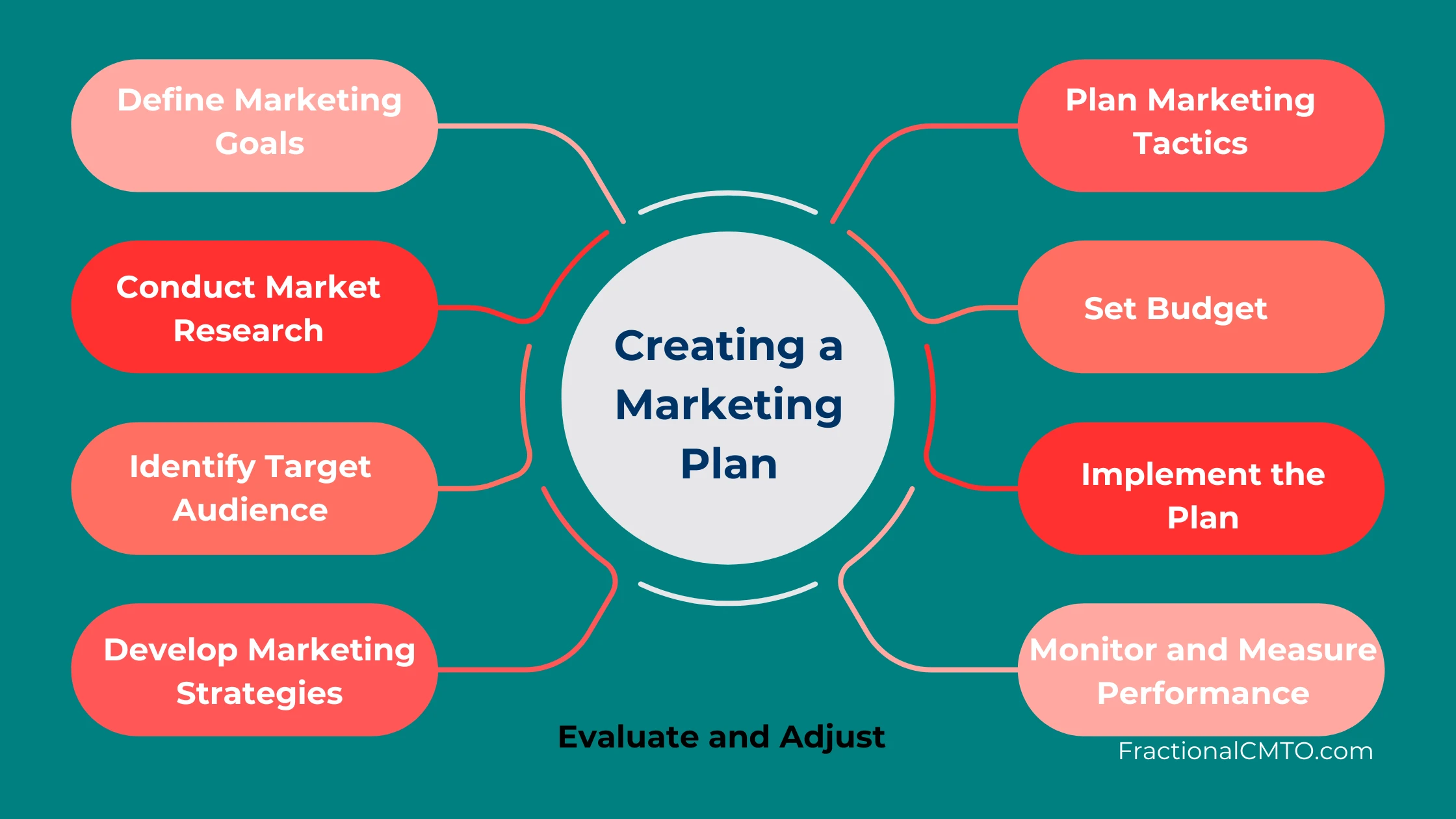
<p>Marketing strategy is the foundation of any successful marketing plan. It outlines the goals, target audience, and tactics for reaching those goals. The marketing strategy covers everything from product positioning to pricing to distribution channels. One key step in creating a marketing plan is defining your target market. Understanding who your customers are and what they need is essential for developing effective messaging and campaigns. Another important aspect is setting specific, measurable goals for your marketing efforts. These goals will help you track progress and make necessary adjustments to your strategy. Ultimately, the marketing strategy must align with your overall business objectives and be flexible enough to adapt to changing market conditions. Remember, your marketing plan is not set in stone; it should be a living document that evolves as your business grows and changes. Each component of your marketing plan, from market research to budgeting to promotional tactics, should be a part of your marketing strategy and work together to help you achieve your business goals.</p>
<p> </p>
<h3 class="wp-block-heading">Setting SMART Marketing Goals</h3>
<p>When developing a marketing strategy, it is crucial to establish clear and achievable goals. One effective method for setting these goals is by using the SMART criteria. This acronym stands for Specific, Measurable, Achievable, Relevant, and Time-bound. By incorporating these elements into your goals, you can ensure that they are well-defined, trackable, realistic, aligned with your business objectives, and have a deadline for completion.</p>
<p> </p>
<p>Specific goals are detailed and focused, making it easier to know exactly what needs to be accomplished. Measurable goals allow you to track progress and determine if you are on the right path. Achievable goals are realistic and within reach, avoiding setting yourself up for failure. Relevant goals are aligned with your overall marketing strategy and business goals. Time-bound goals have a deadline for completion, providing a sense of urgency and motivation to achieve them.</p>
<p> </p>
<h3 class="wp-block-heading">Utilizing Different Marketing Channels</h3>
<p>To create a successful marketing strategy, businesses must utilize a variety of marketing channels to reach their target audience. By spreading their message across different platforms, companies can increase their visibility and attract a wider range of customers. Social media, email marketing, search engine optimization, and traditional advertising are just a few examples of the many marketing channels available to businesses today. Each channel offers its unique benefits and allows companies to engage with customers in different ways. By diversifying their marketing strategy, businesses can ensure that they are reaching as many potential customers as possible and maximizing their overall impact. Additionally, utilizing multiple marketing channels can help businesses adapt to changes in consumer behaviour and stay ahead of the competition. </p>
<p> </p>
<h2 class="wp-block-heading">Strategies for Digital Marketing Success</h2>
<p>Marketing strategy plays a crucial role in the success of digital marketing efforts. One key strategy is to define clear goals and objectives for the campaign. This helps in aligning the marketing tactics with the overall business goals. Another important strategy is to target the right audience by using data analytics and segmentation techniques. By understanding the target audience’s needs and preferences, marketers can create personalized and impactful campaigns. Additionally, utilizing various digital channels such as social media, email marketing, and search engine optimization can help in reaching a wider audience. Finally, analyzing and tracking the performance of the campaigns using key performance indicators (KPIs) is essential to measure the effectiveness of the strategies employed and make necessary adjustments for future campaigns.</p>
<p> </p>
<h3 class="wp-block-heading">Implementing a Digital Marketing Strategy</h3>
<p>Implementing a digital marketing strategy is essential for businesses looking to reach their target audience and increase brand awareness. The first step in this process is defining your goals and objectives. Understanding what you hope to achieve through your marketing efforts will help guide your strategy and ensure that all your efforts are aligned with your overarching business goals. Once you have established your objectives, the next step is to identify your target audience. Knowing who you are trying to reach will allow you to tailor your messaging and content specifically to their needs and interests. After defining your audience, it is important to choose the right channels to reach them. Whether it be social media, email marketing, or search engine optimization, selecting the platforms that will best connect you with your target market is crucial in successfully implementing your digital marketing strategy.</p>
<p> </p>
<h3 class="wp-block-heading">Targeting the Right Audience in Digital Marketing</h3>
<p>Marketing strategy plays a crucial role in any successful digital marketing campaign. One key aspect of a marketing strategy is targeting the right audience. By identifying and reaching out to the right audience, businesses can maximize their resources and increase the chances of converting leads into customers. With the vast amount of data available in the digital world, marketers can use various tools and techniques to pinpoint the specific demographics, interests, and behaviours of their target audience. This allows for more personalized and tailored messaging that resonates with the audience on a deeper level.</p>
<p> </p>
<p>When businesses effectively target the right audience, they can optimize their marketing strategy to focus on the most promising prospects, ultimately driving higher rates of engagement and conversion. By understanding the needs and preferences of their target audience, businesses can create more relevant and compelling content that speaks directly to their target market.</p>
<p> </p>
<h3 class="wp-block-heading">Incorporating Content Marketing in Your Digital Strategy</h3>
<p>Content marketing should be a crucial component of any marketing strategy in today’s digital landscape. By creating and sharing valuable, relevant, and consistent content, businesses can attract and retain a clearly defined audience. This not only helps in building brand awareness but also establishes credibility and trust with potential customers. Content marketing can take various forms such as blog posts, social media updates, videos, and infographics, providing flexibility to reach audiences across different channels.</p>
<p> </p>
<h2 class="wp-block-heading">Understanding the Marketing Mix and Its Importance</h2>
<p>The marketing mix refers to the set of tools and tactics that a company uses to promote its products or services to its target market. It consists of the four Ps: product, price, place, and promotion (Or 5 if it is a physical product as packaging also plays a role). Each of these elements plays a crucial role in the overall marketing strategy of a business. The product is what the company offers to customers, the price is what customers pay for the product, the place is where the product is available for purchase, and promotion is how the company communicates with customers about the product. By carefully considering and balancing these four elements, companies can create a successful marketing mix that effectively reaches and resonates with their target market.</p>
<p> </p>
<p>Having a well-thought-out marketing mix is essential for a company’s success. It allows businesses to tailor their marketing efforts to their target audience, differentiate themselves from competitors, and ultimately drive sales and revenue. A strong marketing mix also helps companies maximize their return on investment and achieve their business goals. By understanding the importance of the marketing mix and how each element contributes to the overall strategy, companies can develop more effective marketing campaigns and better connect with their customers.</p>
<p> </p>
<h3 class="wp-block-heading">Elements of the Marketing Mix</h3>
<p>When developing a marketing strategy, it is essential to consider the various elements of the marketing mix. These elements include product, price, place, and promotion. Each element plays a crucial role in the overall success of a marketing campaign. The product refers to the actual good or service being offered to customers. The price is the amount customers are willing to pay for the product. The place refers to the distribution channels used to make the product available to customers. Finally, promotion involves the communication strategies used to attract and retain customers. By carefully considering each element of the marketing mix, businesses can create a comprehensive and effective marketing strategy that reaches their target audience and achieves their goals.</p>
<p> </p>
<h3 class="wp-block-heading">How to Align the Marketing Mix with Business Goals</h3>
<p>Types of Marketing Strategies for Different Objectives</p>
<p> </p>
<p>Marketing strategy is crucial for achieving different objectives. For companies looking to increase brand awareness, a strong focus on content marketing and social media campaigns can be effective. By creating engaging and valuable content, businesses can attract and retain customers, ultimately boosting their brand recognition. On the other hand, for companies aiming to drive sales, strategies like email marketing and promotions can be more impactful. Through targeted email campaigns and special promotions, businesses can incentivize customers to make a purchase, increasing their revenue. Additionally, for companies focused on expanding their market reach, collaborations and partnerships can be valuable strategies. By teaming up with other businesses or influencers, companies can tap into new audiences and grow their customer base.</p>
<p> </p>
<h3 class="wp-block-heading">Exploring Various Types of Marketing Strategies</h3>
<p>When it comes to implementing a successful marketing strategy, there are various approaches that businesses can take. One common strategy is utilizing social media platforms to reach a larger audience and engage with potential customers. By creating compelling content and running targeted ads, companies can effectively promote their products or services to a specific demographic. Another popular tactic is influencer marketing, where brands collaborate with individuals who have a large following to endorse their products. This can help increase brand awareness and credibility among consumers. Email marketing is also a powerful tool, allowing businesses to directly communicate with their audience and promote new products or offers. By exploring and experimenting with different types of marketing strategies, companies can find the perfect mix that works best for their unique goals and target audience.</p>
<p> </p>
<h3 class="wp-block-heading">Choosing the Right Marketing Strategy for Your Product or Service</h3>
<p>Marketing strategy plays a crucial role in the success of any product or service. When deciding on the right marketing strategy for your offering, it is important to consider factors such as target audience, competition, budget, and brand positioning. Conducting market research to understand consumer behavior and preferences can help tailor your strategy to effectively reach and engage potential customers. Split testing different marketing tactics can help determine what resonates best with your audience, whether it be social media campaigns, influencer partnerships, or traditional advertising methods. It is also essential to track the performance of your marketing efforts and adjust accordingly to maximize results. By carefully selecting and implementing the right marketing strategy, you can increase brand awareness, generate leads, and ultimately drive sales for your product or service.</p>
<p> </p>
<h3 class="wp-block-heading">Comparing Traditional and Digital Marketing Strategies</h3>
<p>Marketing strategy is essential for businesses to promote their products or services effectively. Traditional marketing strategies typically involve methods such as print ads, television commercials, and direct mail. These approaches have been used for decades and are proven to reach a wide audience. However, with the rise of technology, digital marketing strategies have become increasingly popular. Digital marketing includes tactics such as social media advertising, search engine optimization (SEO), and email campaigns. One key difference between traditional and digital marketing is the ability to target specific audiences online. Through data analysis and tracking tools, companies can personalize their marketing efforts to reach the right consumers at the right time. While traditional marketing can still be effective, many businesses are shifting towards digital strategies due to their cost-effectiveness and measurable results. In today’s competitive market, it is important for companies to consider a combination of both traditional and digital marketing strategies to stay ahead of the competition.</p>
<p> </p>
<h2 class="wp-block-heading">Creating a Comprehensive Marketing Strategy Plan</h2>
<p>Marketing strategy is crucial for any business looking to reach its target audience, increase sales, and build brand awareness. A comprehensive marketing strategy plan includes defining the target market, conducting market research, setting clear objectives, and determining the best channels to reach customers. It also involves creating a unique selling proposition, developing a strong brand message, and establishing a budget for marketing initiatives. By outlining these key components, businesses can create a roadmap for their marketing efforts and ensure that all tactics work together to achieve overall goals.</p>
<p> </p>
<p>When creating a comprehensive marketing strategy plan, it is important to consider the various marketing tools and techniques available, such as social media, email marketing, content marketing, and advertising. By using a mix of these tactics, businesses can effectively reach their target audience and drive engagement. It is also essential to track and analyze the results of each marketing initiative to determine what is working and what needs to be adjusted. By continuously refining the marketing strategy plan based on data and insights, businesses can stay ahead of the competition and drive long-term success.</p>
<p> </p>
<h3 class="wp-block-heading">Structuring an Effective Marketing Strategy</h3>
<p>Marketing strategy is essential for any business to achieve its goals and target the right audience effectively. A comprehensive marketing strategy plan involves conducting market research, identifying target customers, defining clear objectives, and establishing key performance indicators to measure success. This plan should include a mix of online and offline marketing tactics, such as social media campaigns, email marketing, SEO strategies, and traditional advertising methods. It is crucial to align the marketing strategy with the overall business goals and budget constraints to ensure maximum impact and return on investment. Regularly reviewing and adjusting the marketing strategy plan based on market trends and performance data is also important to stay ahead of the competition and maintain relevance in the marketplace.</p>
<p> </p>
<h3 class="wp-block-heading">Detailing Marketing Tactics and Activities</h3>
<p>Marketing strategy is essential for any business looking to grow and expand. This involves carefully planning and executing various marketing tactics and activities to reach the target audience and drive sales. One common tactic is utilizing social media platforms to engage with potential customers and build brand awareness. By posting relevant content, running targeted ads, and engaging with followers, businesses can create a strong online presence and attract new customers. Another effective tactic is email marketing, where businesses can send personalized messages to subscribers with special offers or updates about products and services. Additionally, collaborating with influencers or partnering with other businesses can help expand reach and attract new customers. Overall, a well-thought-out marketing strategy with a mix of tactics and activities is crucial for achieving success in today’s competitive market.</p>
<p> </p>
<h2 class="wp-block-heading">Help and Support With Your Marketing Strategy</h2>
<p>Working with experts in marketing like us, who can provide valuable insights and guidance to help you refine and optimize your strategy. From advising on how to conduct market research to identifying target audiences and creating compelling messaging, we can help you develop a comprehensive plan that aligns with your business goals and objectives.</p>
<p>In addition to expert consultation, there are a variety of training programs and resources available to help you enhance your marketing skills and knowledge. From online courses to workshops and conferences, investing in continuous learning can help you stay ahead of the curve and adapt to changing market trends. We also offer bespoke training options for clients should this be required. </p>]]>
            </summary>
                            <link rel="enclosure" href="https://static.forento.site/fs/forento/userFiles/fractionalcmto/images/a-20-mastering-marketing-strategy-17683984857669.png" length="59401" type="image/png" />
                        <category term="Marketing" />
            <updated>2026-01-16T14:08:00+00:00</updated>
                            <dc:description><![CDATA[Developing a marketing strategy involves a series of steps to help businesses effectively promote their products or services. The 7 steps of marketing strategy typically include...]]></dc:description>
                    </entry>
            <entry>
            <title><![CDATA[Why Should You Consider Hiring a Fractional CMO as Your Chief Marketing Officer?]]></title>
            <link rel="alternate" href="https://www.fractionalcmto.com/insights/about/why-should-you-consider-hiring-a-fractional-cmo-as-your-chief-marketing-officer-1" />
            <id>https://www.fractionalcmto.com/insights/about/why-should-you-consider-hiring-a-fractional-cmo-as-your-chief-marketing-officer-1</id>
            <author>
                <name><![CDATA[Fractional CMTO]]></name>
                                    <email><![CDATA[4937@ucraft.forento.io]]></email>
                            </author>
            <summary type="html">
                <![CDATA[<p><strong>Hiring a fractional CMO as your Chief Marketing Officer</strong> can be a strategic move for your organisation’s marketing leadership. A fractional CMO brings a deep understanding of modern marketing trends and digital marketing strategies, enhancing your company’s marketing efforts. By having a fractional CMO on board, you can leverage their expertise to develop and execute a comprehensive marketing plan that aligns with your business goals. They can work closely with your marketing team to optimize marketing performance, improve customer experience, and drive brand awareness. Additionally, a fractional CMO can provide valuable insights through analytics to measure the effectiveness of your marketing communications.</p>
<p> </p>
<p><strong>CMOs must</strong> report directly to the c-suite, including the chief executive officer, and collaborate with other senior marketing and product marketing executives. As the leader of the marketing function, a successful CMO is responsible for the overall success of the company’s marketing efforts. This includes overseeing the marketing department, setting the marketing strategy, and ensuring that the organization stays ahead of market trends. A fractional CMO can bring a fresh perspective to the cmo role, helping your organization navigate the complexities of new marketing channels and technologies.</p>
<h2 class="wp-block-heading">What Does a Fractional Chief Marketing Officer Bring to Your Marketing Strategy?</h2>
<p><strong>What Does a Fractional CMO Bring to Your Marketing Strategy?</strong> A fractional CMO brings a wealth of experience in marketing leadership to your organization. With a Cheshire understanding of every aspect within the marketing realm, a fractional CMO can take on the role of head of marketing seamlessly. Their job description typically involves managing marketing strategies that align with the overall goals of the company. A fractional CMO must have a degree in marketing and a strong background in developing and implementing innovative marketing tactics. They also bring a strategic thinking approach to the table, using data analytics and strategic planning to drive marketing success.</p>
<p>Additionally, a fractional CMO may bring a fresh perspective to your marketing team, offering new ideas and insights that can help your company stand out in a crowded market. CMOs need to have experience in global marketing and should be responsible for overseeing marketing strategies that align with the company’s goals. With their expertise in managing marketing tools, a fractional CMO can bring a level of expertise that you may not have in-house.</p>
<h3 class="wp-block-heading">Role of the CMO in Driving Growth</h3>
<p>Every marketing professional aspires to become a CMO, the marketing leader within the marketing department. CMOs are responsible for developing and implementing marketing strategies that drive business growth. The CMO needs to evaluate the effectiveness of marketing campaigns, including social media marketing, email marketing, and other channels. They work directly with the Chief Executive Officer (CEO) and often collaborate with other C-suite executives, such as the Chief Financial Officer (CFO) and Chief Customer Officer. According to a recent CMO survey, CMOs and marketing leaders are increasingly focused on driving growth within their organizations.</p>
<p>The CMO’s roles and responsibilities include setting marketing objectives, evaluating the effectiveness of marketing tactics, and identifying areas for improvement. They must also stay up-to-date on industry trends and new technologies to drive business growth. CMOs play a crucial role in shaping the overall strategy of the company and must be creative and data-driven in their approach to marketing.</p>
<h3 class="wp-block-heading">Responsibilities of a Fractional CMO</h3>
<p><strong>Responsibilities of a Fractional CMO</strong></p>
<p><strong>CMO works</strong> closely with the CEO to develop and execute <strong>growth strategies</strong> for the company. As the <strong>chief growth officer</strong>, the Fractional CMO is responsible for driving revenue and expanding the business. This includes creating and implementing marketing plans, analyzing market trends, and identifying new opportunities for growth. The Fractional CMO also oversees the marketing team and ensures that all initiatives align with the company’s overall objectives.</p>
<p><strong>Reporting directly to the CEO</strong>, the Fractional CMO plays a crucial role in shaping the company’s future. By collaborating with other executives and key stakeholders, the Fractional CMO helps drive innovation and drive the company towards success. With a deep understanding of both marketing and business operations, the Fractional CMO is able to provide valuable insights and guidance to the leadership team.</p>
<h2 class="wp-block-heading">How Can a Fractional CMO Benefit Your Organization?</h2>
<p><strong>Fractional CMO (Chief Marketing Officer)</strong> can benefit your organization in several ways. Firstly, by hiring a fractional CMO, you gain access to a high-level marketing expert without the commitment of a full-time executive. This allows your organization to leverage the expertise and experience of a seasoned professional on a part-time basis, saving on costs while still benefiting from strategic marketing guidance. Secondly, a fractional CMO can provide a fresh perspective and innovative ideas to your marketing strategy, helping to drive growth and improve overall performance. Additionally, fractional CMOs can fill in gaps in your existing marketing team, offering support in areas where you may not have the expertise in-house. Overall, bringing in a fractional CMO can lead to increased efficiency, effectiveness, and success for your organization’s marketing efforts.</p>
<h3 class="wp-block-heading">Implementing Marketing Activities Effectively</h3>
<p>When it comes to implementing marketing activities effectively, it is important to have a well-thought-out strategy in place. This includes clearly defining your target audience, setting measurable goals, and utilizing various marketing channels to reach them. A key aspect of effective marketing is consistency; it is crucial to maintain a consistent brand image and messaging across all platforms. This helps to build trust and credibility with your audience.</p>
<p>Another important factor in implementing marketing activities effectively is monitoring and analyzing the performance of your campaigns. By tracking key metrics such as conversion rates, engagement levels, and return on investment, you can identify what is working well and what areas need improvement. This data-driven approach allows you to make informed decisions and optimize your marketing efforts for better results.</p>
<h3 class="wp-block-heading">Enhancing the Role of Marketer in the Team</h3>
<p><strong>Enhancing</strong> the role of a <strong>marketer</strong> in the team is crucial for the success of any marketing campaign. It is important for marketers to constantly <strong>evolve</strong> and <strong>adapt</strong> to new trends and technologies in the industry. By <strong>enhancing</strong> their role, marketers can bring fresh ideas and perspectives to the team, ultimately <strong>improving</strong> the overall performance and <strong>effectiveness</strong> of the marketing efforts.</p>
<p>One way to <strong>enhance</strong> the role of a marketer in the team is to <strong>encourage</strong> <strong>collaboration</strong> and <strong>communication</strong> with other team members. By working closely with colleagues from different departments, marketers can gain valuable insights and <strong>feedback</strong> that can help <strong>inform</strong> their strategies and decision-making processes.</p>
<p>Another important aspect of <strong>enhancing</strong> the role of a marketer in the team is to <strong>invest</strong> in ongoing <strong>training</strong> and <strong>development</strong>. By staying up-to-date on the latest marketing <strong>trends</strong> and <strong>techniques</strong>, marketers can <strong>continuously</strong> <strong>improve</strong> their skills and <strong>capabilities</strong>.</p>
<h3 class="wp-block-heading">Optimizing the Marketing Budget with a Fractional CMO</h3>
<p><strong>Optimizing the Marketing Budget with a Fractional CMO</strong></p>
<p>When it comes to maximizing the efficiency of your marketing budget, hiring a <strong>Fractional CMO</strong> can be a game-changer. A <strong>Fractional CMO</strong> is a cost-effective alternative to a full-time Chief Marketing Officer, providing expert guidance and strategy without the hefty price tag. By working with a <strong>Fractional CMO</strong>, you can access specialized marketing knowledge and skills on a part-time basis, allowing you to allocate your budget more efficiently.</p>
<p>With a <strong>Fractional CMO</strong> on board, you can benefit from their strategic insights and industry expertise to make informed decisions about where to invest your marketing dollars. They can help you prioritize marketing initiatives that will deliver the greatest return on investment, ensuring that every dollar spent is contributing to your overall business objectives.</p>
<p>Overall, partnering with a <strong>Fractional CMO</strong> can help you optimize your marketing budget, increase your marketing effectiveness, and drive greater ROI for your business. It’s a smart investment that can yield significant results in the long run.</p>
<h2 class="wp-block-heading">When Should You Consider Hiring a Fractional CMO?</h2>
<p><strong>When should you consider hiring a Fractional CMO?</strong></p>
<p>As a growing business, it can be challenging to balance all aspects of marketing while also focusing on day-to-day operations. This is where a <strong>Fractional CMO</strong> can come in handy. When you feel overwhelmed with creating and implementing marketing strategies, it might be time to consider bringing in a <strong>Fractional CMO</strong>. They can provide expert guidance and direction, without the commitment of a full-time executive.</p>
<p>Another sign that you may need a <strong>Fractional CMO</strong> is when you are looking to scale your marketing efforts but are unsure of the best approach. A <strong>Fractional CMO</strong> can bring fresh perspectives and industry knowledge to help you reach your goals more effectively.</p>
<p>Overall, if you find yourself struggling to keep up with the demands of marketing while also trying to grow your business, it may be time to consider hiring a <strong>Fractional CMO</strong> to provide the expertise and support you need.</p>
<h3 class="wp-block-heading">Signs that Your Organization Needs a Fractional CMO</h3>
<p><strong>Signs that Your Organization Needs a Fractional CMO</strong></p>
<p>1. <strong>Marketing Strategy Not Aligned:</strong> If your marketing strategy is not aligned with your business goals or if you are struggling to define and execute a solid marketing plan, it may be time to bring in a fractional CMO. They can help assess your current strategy and develop a cohesive plan that drives results.</p>
<p>2. <strong>Lack of Internal Marketing Expertise:</strong> If your team lacks the expertise or experience needed to drive successful marketing initiatives, hiring a fractional CMO can provide the strategic guidance and leadership necessary to elevate your marketing efforts.</p>
<p>3. <strong>Stagnant Growth:</strong> If your organization is experiencing stagnant growth or declining sales, a fractional CMO can bring fresh perspectives and innovative ideas to revitalize your marketing approach and drive growth.</p>
<p>4. <strong>Need for Specialized Skills:</strong> If your organization requires specialized marketing skills or expertise that are not available within your current team, a fractional CMO can fill those gaps by providing the specific knowledge and capabilities needed to succeed in today’s competitive market.</p>
<h3 class="wp-block-heading">The Impact of Fractional CMO on Company’s Growth</h3>
<p><strong>Fractional CMO (Chief Marketing Officer)</strong> can have a significant impact on a company’s growth by providing expertise and strategic direction in marketing efforts. They bring a wealth of experience and knowledge to the table, helping to shape and execute marketing campaigns that drive sales and increase brand awareness. Having a <strong>Fractional CMO</strong> on board allows companies to access high-level marketing talent without the hefty price tag of a full-time executive. This cost-effective solution enables businesses to leverage the skills and insights of a seasoned marketing professional without committing to a long-term contract. By working closely with the leadership team, a <strong>Fractional CMO</strong> can help identify new opportunities for growth, optimize marketing strategies, and boost overall performance. With their guidance, companies can achieve greater market penetration, increased customer engagement, and ultimately, accelerated growth.</p>
<h2 class="wp-block-heading">What Skills Should a Successful Fractional CMO Possess?</h2>
<p>A successful Fractional CMO should possess a diverse set of skills to effectively lead marketing initiatives for multiple clients. Firstly, they should have strong <strong>strategic planning</strong> skills to develop comprehensive marketing strategies that align with each client’s goals and objectives. This includes identifying target audiences, analyzing market trends, and setting clear objectives for all marketing campaigns. Additionally, a Fractional CMO should have <strong>strong communication</strong> skills to effectively collaborate with internal teams and external partners to execute marketing programs successfully. This includes the ability to articulate ideas clearly, delegate tasks efficiently, and provide constructive feedback to ensure all stakeholders are on the same page. Furthermore, a successful Fractional CMO should have <strong>analytical skills</strong> to track and measure the performance of marketing initiatives, identify areas for improvement, and make data-driven decisions to optimize campaign outcomes. Lastly, a Fractional CMO should have <strong>leadership</strong> skills to inspire and motivate team members, foster a culture of innovation, and drive continuous improvement within the organization.</p>
<h3 class="wp-block-heading">Marketing Strategies and Brand Management</h3>
<p><strong>Marketing Strategies and Brand Management</strong></p>
<p>Effective <strong>marketing strategies</strong> are essential for a brand to succeed in the competitive marketplace. By identifying target audiences, conducting market research, and establishing a unique value proposition, companies can create a strong foundation for their marketing efforts. Utilizing various channels such as social media, email marketing, and content marketing, brands can reach their target audiences and engage with them in a meaningful way. Moreover, an integrated approach to marketing that aligns with the brand’s values and goals is key to attracting and retaining customers.</p>
<p>On the other hand, <strong>brand management</strong> focuses on maintaining and enhancing the reputation and perception of a brand in the eyes of consumers. This involves monitoring brand assets, ensuring consistency in messaging and visuals, and responding effectively to any crises or negative publicity. By actively managing the brand, companies can build trust and loyalty among consumers, ultimately leading to long-term success.</p>
<h3 class="wp-block-heading">Utilizing Marketing Technology for Growth</h3>
<p><strong>Utilizing Marketing Technology for Growth</strong></p>
<p>With the rapid advancement of technology, businesses are constantly looking for innovative ways to grow and expand their reach. One of the most effective strategies for achieving this goal is by utilizing <strong>marketing technology</strong>. By leveraging tools such as <strong>CRM systems</strong>, <strong>automation software</strong>, and <strong>data analytics platforms</strong>, companies can streamline their marketing efforts, target the right audience, and track the effectiveness of their campaigns. This allows businesses to make data-driven decisions, optimize their marketing strategies, and ultimately drive growth and revenue. Additionally, marketing technology enables companies to personalize their messaging, engage with customers on a more personal level, and build lasting relationships. In today’s competitive landscape, staying ahead of the curve and utilizing marketing technology is key to sustainable growth and success.</p>
<h2 class="wp-block-heading">How Does a Fractional CMO Drive Revenue Growth?</h2>
<p>A <strong>Fractional CMO</strong> can drive revenue growth in several ways. Firstly, they bring a high level of expertise and strategic thinking to the marketing function, helping to identify and prioritize activities that will have the biggest impact on revenue. By developing and implementing a comprehensive marketing strategy, they can attract new customers, increase customer retention, and drive overall business growth. <strong>Fractional CMOs</strong> also have access to a network of marketing specialists and agencies, allowing them to quickly scale up campaigns and initiatives as needed. Additionally, they provide valuable insights and data analysis, enabling businesses to make data-driven decisions that will optimize their marketing efforts and drive revenue growth. Overall, a <strong>Fractional CMO</strong> can be a valuable asset for companies looking to accelerate their revenue growth through strategic marketing initiatives.</p>
<h3 class="wp-block-heading">Developing Marketing Initiatives for Revenue Boost</h3>
<p><strong>Developing Marketing Initiatives for Revenue Boost</strong></p>
<p>When looking to increase revenue, businesses often turn to developing <strong>marketing initiatives</strong> to attract new customers and retain existing ones. This involves creating <strong>strategies</strong> that not only promote the brand and its products or services, but also drive sales and generate more <strong>profit</strong>. By analyzing market trends, consumer behavior, and competitors, companies can tailor their <strong>marketing campaigns</strong> to target specific demographics and optimize their reach. Utilizing various <strong>channels</strong> such as social media, email marketing, and advertising, businesses can effectively communicate their value proposition and entice customers to make a purchase. Implementing <strong>metrics</strong> to track the success of these initiatives is crucial in determining their effectiveness and making adjustments as needed to continue driving revenue growth.</p>
<h3 class="wp-block-heading">Overseeing Marketing Campaigns and Market Research</h3>
<p>When <strong>overseeing marketing campaigns</strong>, it is crucial to ensure that all aspects of the campaign are running smoothly and effectively. This includes coordinating with various teams to develop the overall strategy, creating compelling content and visuals, and monitoring the campaign’s performance to make necessary adjustments. <strong>Market research</strong> is also a vital component of any successful marketing campaign. By conducting thorough research on the target audience, competitors, and industry trends, marketing professionals can better understand the market landscape and tailor their campaigns to drive maximum impact. Using techniques like surveys, focus groups, and data analysis, marketers can gather valuable insights that inform their strategies and help them make informed decisions.</p>]]>
            </summary>
                            <link rel="enclosure" href="https://static.forento.site/fs/forento/userFiles/fractionalcmto/images/a-14-why-fractional-cmo-17683976516599.png" length="250446" type="image/png" />
                        <category term="About" />
            <updated>2026-01-16T14:06:05+00:00</updated>
                            <dc:description><![CDATA[Hiring a fractional CMO as your Chief Marketing Officer can be a strategic move for your organisation’s marketing leadership.]]></dc:description>
                    </entry>
            <entry>
            <title><![CDATA[Understanding the Role of a Fractional Chief Marketing Technology Officer (CMTO)]]></title>
            <link rel="alternate" href="https://www.fractionalcmto.com/insights/about/understanding-the-role-of-a-fractional-chief-marketing-technology-officer-cmto" />
            <id>https://www.fractionalcmto.com/insights/about/understanding-the-role-of-a-fractional-chief-marketing-technology-officer-cmto</id>
            <author>
                <name><![CDATA[Fractional CMTO]]></name>
                                    <email><![CDATA[4937@ucraft.forento.io]]></email>
                            </author>
            <summary type="html">
                <![CDATA[<h2 class="wp-block-heading">What is a fractional chief marketing technology officer (CMTO)?</h2>
<p> </p>
<p>A fractional chief marketing technology officer, often referred to as a CMTO, is a professional who plays a pivotal role in aligning marketing and technology within an organization. The key function of a CMTO is to bridge the gap between traditional marketing strategies and cutting-edge technology solutions to drive business growth.</p>
<p> </p>
<h3 class="wp-block-heading">Defining the role of a CMTO</h3>
<p>The role of a CMTO involves overseeing the integration of marketing operations with technology systems to enhance marketing efficiency and effectiveness. They are responsible for implementing marketing automation tools, utilizing customer data insights, and maximizing the use of marketing clouds to streamline processes.</p>
<p> </p>
<h3 class="wp-block-heading">Responsibilities of a fractional CMTO</h3>
<p>A fractional CMTO is accountable for developing and executing comprehensive marketing strategies that leverage the latest marketing technologies. They also focus on measuring the ROI of marketing campaigns and ensuring that these campaigns align with the overall business goals of the organization. Fractional CMTO’s are usually brought in to set up specific projects or solutions and to train the marketing team in how to make full use of them. </p>
<p> </p>
<h3 class="wp-block-heading">Benefits of hiring a fractional CMTO</h3>
<p>By bringing in a fractional CMTO, organizations can benefit from a unique blend of marketing expertise and technological expertise. This individual can drive business success by implementing data-driven marketing decisions, optimizing digital marketing tools, and enhancing the organization’s marketing performance.</p>
<p> </p>
<h2 class="wp-block-heading">How does a CMTO blend marketing and technology?</h2>
<p>The harmonious blend of marketing and technology is crucial in today’s digital age where businesses rely heavily on data-driven insights and technological innovations to connect with their target audience effectively. A CMTO acts as the linchpin between marketing strategies and technology solutions.</p>
<p> </p>
<h3 class="wp-block-heading">Importance of merging marketing and technology</h3>
<p>The integration of marketing and technology is essential for staying competitive in the market. A CMTO ensures that marketing initiatives are supported by cutting-edge technology tools, enabling the organization to drive impactful campaigns and achieve business growth.</p>
<p> </p>
<h3 class="wp-block-heading">Challenges faced by CMTO in aligning marketing and technology strategies in their strategic role</h3>
<p>One of the primary challenges for a CMTO is balancing the need for innovative marketing techniques with the practicality of technology implementation. Navigating these challenges requires a deep understanding of both marketing principles and technological advancements.</p>
<p> </p>
<h3 class="wp-block-heading">Key skills required for a successful CMTO</h3>
<p>A successful CMTO possesses a diverse skill set that includes expertise in digital marketing, analytics, campaign management, and technology integration. Strong leadership, strategic vision, and the ability to drive business results are also crucial for excelling in this role.</p>
<p> </p>
<h2 class="wp-block-heading">What is the relationship between a CMTO, CMO, and CTO?</h2>
<p>The roles of a CMTO, Chief Marketing Officer (CMO), and Chief Technology Officer (CTO) are interlinked within an organization, each serving a distinct yet complementary function in driving marketing technology initiatives and business growth.</p>
<p> </p>
<h3 class="wp-block-heading">Distinguishing roles of a CMTO, CMO, and CTO</h3>
<p>A CMTO focuses on aligning marketing strategies with technological capabilities, a CMO oversees the overall marketing efforts, and a CTO is responsible for the technological infrastructure and innovations within the organization. Each role brings a unique perspective to the table.</p>
<p> </p>
<h3 class="wp-block-heading">Collaboration between a CMTO, CMO, and CTO in driving marketing technology initiatives</h3>
<p>Effective collaboration among a CMTO, CMO, and CTO is crucial for successfully implementing marketing technology solutions. By working in tandem, these professionals can leverage their expertise to create holistic marketing strategies that drive business growth and enhance customer engagement.</p>
<p> </p>
<h3 class="wp-block-heading">How a CMTO can complement the functions of a CMO and a CTO</h3>
<p>A CMTO acts as a bridge between the marketing and technology functions of an organization, ensuring seamless integration and alignment of strategies. By complementing the roles of the CMO and CTO, a CMTO helps in maximizing the impact of marketing initiatives and achieving the desired business outcomes.</p>
<p> </p>
<h2 class="wp-block-heading">How does a CMTO drive digital marketing strategies and analytics?</h2>
<p>Utilizing digital marketing tools and analytics is essential for modern businesses to stay competitive in the dynamic marketplace. A CMTO leverages data-driven insights, implements innovative marketing strategies, and optimizes digital channels to drive successful marketing campaigns.</p>
<p> </p>
<h3 class="wp-block-heading">Implementing analytics for data-driven marketing decisions</h3>
<p>A CMTO uses analytics to track the performance of marketing campaigns, analyze customer behavior, and make informed decisions based on measurable results. By harnessing the power of analytics, organizations can refine their marketing strategies and enhance their ROI.</p>
<p> </p>
<h3 class="wp-block-heading">Measuring the success of marketing campaigns under a CMTO’s leadership</h3>
<p>Under the guidance of a CMTO, organizations can measure the success of their marketing campaigns more effectively. By analyzing key performance indicators and tracking the impact of marketing initiatives, businesses can make data-driven adjustments to optimize their marketing activities.</p>
<p> </p>
<h2 class="wp-block-heading">How can an organization leverage a CMTO to align marketing efforts?</h2>
<p>Aligning marketing efforts with organizational goals is crucial for driving business growth and maximizing the impact of marketing initiatives. By leveraging the expertise of a CMTO, organizations can optimize their marketing strategies and enhance their competitive edge in the market.</p>
<p> </p>
<h3 class="wp-block-heading">Strategies for aligning marketing efforts with organizational goals</h3>
<p>A CMTO develops tailored strategies that align marketing efforts with the overarching goals of the organization. By understanding the business objectives and leveraging technology solutions, a CMTO can orchestrate marketing campaigns that resonate with the target audience and drive desired outcomes.</p>
<p> </p>
<h3 class="wp-block-heading">Implementing technology solutions to streamline marketing processes</h3>
<p>Technology plays a pivotal role in streamlining marketing processes and enhancing marketing efficiency. A CMTO leverages martech solutions, automation tools, and integration platforms to optimize marketing operations, analyze customer data, and deliver personalized experiences to consumers.</p>
<p> </p>
<h3 class="wp-block-heading">Maximizing the impact of marketing initiatives through the guidance of a CMTO</h3>
<p>With a CMTO at the helm, organizations can maximize the impact of their marketing initiatives by implementing data-driven strategies, optimizing marketing channels, and measuring the effectiveness of their campaigns. The expertise of a CMTO ensures that marketing efforts are aligned with business objectives for sustainable growth.</p>]]>
            </summary>
                            <link rel="enclosure" href="https://static.forento.site/fs/forento/userFiles/fractionalcmto/images/a-13-cmto-735-x-885-px-17683974423139.png" length="272884" type="image/png" />
                        <category term="About" />
            <updated>2026-01-16T13:50:11+00:00</updated>
                            <dc:description><![CDATA[A Chief Marketing Technology Officer combines both marketing and technology experience and as a CMTO they foster business growth through the use of these combined skills. ]]></dc:description>
                    </entry>
    </feed>